 FROM SEQUENCE 1
February 1999
Later published in Choices: A Chapbook (World Voices, Web del Sol)
Much, much later, in December 2024, I have added versions en français y una versión en español. There is also an Addendum section in English.
The riddle of the two miners
In a book on investing I came across a riddle of two miners who emerge from a mine, one with a clean face, the other with a dirty one. The question is, which of the two will wash?
The author offers three possible answers:
- The dirty one.
- The two miners will look at one another, and, seeing his partner’s clean face, the dirty one will assume that his own is clean, and vice-versa. So the clean one will wash.
- It’s a bogus riddle, based on a false assumption; it’s impossible for two men to be so differently affected by the same experience.
In my experience the correct answer is none of the above; rather, the clean one will wash his face because his appearance coming out of the mine reveals his commitment to cleanliness.
I learned this (or learned that this is what subconsciously I believed) from the former employee communications director of a major corporation. When he was forced to golden-parachute and became a consultant, he made a list of all the major corporations whose employee communications were, let’s say, “dirty” — that is, in need of great improvement. He approached the managements of all these companies and did not get the first job. So then he turned to the “clean” companies, those whose internal communications were so good, they didn’t seem to have any need for his services. Quickly he had more work than he could handle.
Addendum
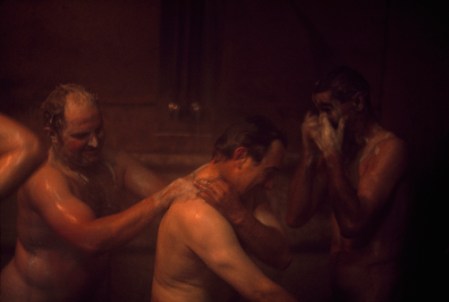
The image used above to illustrate this very short essay is by a National Geographic and Vietnam War photographer, the late Gordon Gahan. (Photo of coal miners in Nova Scotia; National Geographic Stock.) More than a decade later I came across a quote from Gahan on a photoquotes.com website:
I hope that my photographs bring to the reader what my work brings to me: questions, more questions and a fascination with history. A grower of taro roots in French Polynesia put it this way: “What you want to know nobody knows. What you want to see cannot be seen.”

Around the same time I also re-encountered the riddle in a book of essays, Death’s Following: Mediocrity, Dirtiness, Adulthood, Literature

You might say that this brings us to the Zen story I discuss in The Master. But the Zen story takes the next step, with the abused student finally learning a lesson (and perhaps the lesson) and shifting from abused to abuser. Whether this has anything to do with “Jewish logic,” I leave for readers to decide.
Français
L’énigme des deux mineurs
Dans un livre sur l’investissement, j’ai trouvé une devinette sur deux mineurs qui sortent d’une mine, l’un avec le visage propre, l’autre avec le visage sale. La question est la suivante : lequel des deux se lavera ?
L’auteur propose trois réponses possibles :
- La première : celui qui est sale.
- La deuxième : les deux mineurs se regarderont et, voyant le visage propre de son partenaire, le sale supposera que le sien est propre, et vice versa. C’est donc celui qui est propre qui se lavera.
- Troisièmement : il s’agit d’une fausse énigme, basée sur une fausse hypothèse ; il est impossible que deux hommes soient affectés de manière aussi différente par la même expérience. Si la mine est sale, les deux hommes en sortiront avec un visage sale.
D’après mon expérience, la bonne réponse n’est aucune de ces trois. Au contraire, celui qui est propre se lavera le visage parce que son apparence à la sortie de la mine révèle son attachement à la propreté.
J’ai appris cela (ou appris que c’est ce que je croyais inconsciemment) de un ancien directeur de la communication d’une grande entreprise. Lorsqu’il a été contraint de prendre sa retraite, il est devenu consultant. Il a dressé une liste de toutes les grandes entreprises dont la communication avec les employés était, disons, « sale ». C’est-à-dire qu’elle avait besoin d’une amélioration majeure. Il a approché les dirigeants de toutes ces entreprises et n’a pas obtenu le premier emploi. Il s’est donc adressé aux entreprises « propres », celles dont la communication interne était si bonne qu’elles ne semblaient pas avoir besoin de ses services. Rapidement, il a eu plus de travail qu’il ne pouvait en gérer.
Español
El acertijo de los dos mineros
En un libro sobre inversión encontré un acertijo de dos mineros que salen de una mina, uno con la cara limpia, el otro con la cara sucia. La pregunta es: ¿cuál de los dos se lavará?
El autor ofrece tres posibles respuestas:
- La primera: El sucio.
- La segunda: Los dos mineros se mirarán y, al ver la cara limpia de su compañero, el sucio supondrá que la suya está limpia, y viceversa. Así que el limpio se lavará.
- La tercera: Es un acertijo falso, basado en una suposición falsa; es imposible que dos hombres se vean afectados de forma tan diferente por la misma experiencia. Si la mina está sucia, ambos saldrán con la cara sucia.
En mi experiencia, la respuesta correcta no es ninguna de estas tres esas treces. Más bien, el limpio se lavará la cara porque su aspecto al salir de la mina revela su compromiso con la limpieza.
Aprendí esto (o aprendí que esto es lo que inconscientemente creía) del antiguo director de comunicación de una gran empresa. Cuando se vio obligado a retirarse, se convirtió en consultor. Hizo una lista de todas las grandes empresas cuyas comunicaciones con los empleados estaban, digamos, «sucias». Es decir, necesitaban grandes mejoras. Se dirigió a los directivos de todas estas empresas y no consiguió el primer trabajo. Así que se dirigió a las empresas «limpias», aquellas cuyas comunicaciones internas eran tan buenas que no parecían necesitar sus servicios. Rápidamente tuvo más trabajo del que podía manejar.
— William Eaton
 montaigbakhtinian