English followed by une version en français y una versión en español. There is also a Notes section in English.
La perle du lac
 We can imagine that every human being over a certain age has stories to tell – disasters or rare opportunities, secrets. Yet of some there is little to be said. Oh, there was some job or hobby, a divorce handled by the lawyers, a child sent off to boarding-school who comes occasionally to visit.
Her father, a surgeon, had made enough money that, though she did not think of herself as rich, money was not something she worried about. Some might say that the great question of her life was how to fill the time, but she did not see it that way. The time filled itself. Someone would recommend a book to her. Her ex-in-laws were proposing that she join them for a visit to the towns along Lake Geneva. In London, where she lived, there was a masseur who knew how to relieve sexual tension.
She liked of an afternoon to read a newspaper or news magazine. She felt like she was learning about another tribe or species, people more active and engaged. Lately they had become worried about loneliness—the loneliness of old age, the loneliness of working from home, of looking for love on the Internet. She would not have said that she had any real friends, though of course she was invited to social events and occasionally gave dinners in her home. But, except when she was reading a newspaper, loneliness was not something she thought about.
You might imagine this to be the lead up to a story that begins during that visit to Switzerland. There she meets a man who is sure she’ll be interested in what he’s interested in. He takes her to dinner at an elegant restaurant overlooking the water. Her way of politely thanking such men avoided any further complications.
Notes
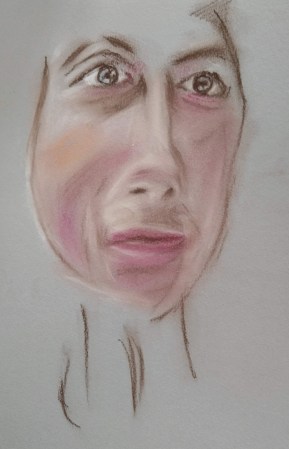
 This story might seem an extension of my recent essay On Filling the Time. In fact, I was reading The Eustace Diamonds (1871-73) and was impressed by Trollope’s description of Lady Eustace’s face, which description I have copied below. The next day I had some time to pass before a dinner with friends and was sitting on the terrace of a lakeside restaurant in Geneva: La Perle du Lac. Nearby, facing me, was a woman, about 50 years old. I decided to try to describe her face with the mixture of physical detail and moral judgments found in the Trollope passage.
I faced several handicaps. I was not in the habit of considering people’s looks in Trollope’s nineteenth-century manner, nor did I know anything about the woman facing me or have a character and story which her face was to illustrate. I was starting from scratch. But I covered a page with observations and then wrote this very short story about the fictional woman who was beginning to come to life in my notebook. It is interesting to me that the story does not make a single reference to the woman’s appearance. Literary styles change!
It has occurred to me that my fiction might have also been slightly influenced by Anita Brookner’s 1992 novel, Hotel du Lac, in which Edith, a romance-novel writer from London, visits Lake Geneva (le Lac Léman). When I look up this book in my notes, however, I find only this: “The company of their own sex, Edith reflected, was what drove many women into marriage.”
Anthony Trollope, The Eustace Diamonds, Chapter II: Lady Eustace:
Her face was oval,—somewhat longer than an oval,—with little in it, perhaps nothing in it, of that brilliancy of colour which we call complexion. And yet the shades of her countenance were ever changing between the softest and most transparent white, and the richest, mellowest shades of brown. It was only when she simulated anger,—she was almost incapable of real anger,—that she would succeed in calling the thinnest streak of pink from her heart, to show that there was blood running in her veins. Her hair, which was nearly black,—but in truth with more of softness and of lustre than ever belong to hair that is really black,—she wore bound tight round her perfect forehead, with one long love-lock hanging over her shoulder. The form of her head was so good that she could dare to carry it without a chignon, or any adventitious adjuncts from an artiste’s shop. Very bitter was she in consequence when speaking of the head-gear of other women. Her chin was perfect in its round, not over long,—as is the case with so many such faces, utterly spoiling the symmetry of the countenance. But it lacked a dimple, and therefore lacked feminine tenderness. Her mouth was perhaps faulty in being too small, or, at least, her lips were too thin. There was wanting from the mouth that expression of eager-speaking truthfulness which full lips will often convey. Her teeth were without flaw or blemish, even, small, white, and delicate; but perhaps they were shown too often. Her nose was small, but struck many as the prettiest feature of her face, so exquisite was the moulding of it, and so eloquent and so graceful the slight inflations of the transparent nostrils. Her eyes, in which she herself thought that the lustre of her beauty lay, were blue and clear, bright as cerulean waters. They were long large eyes,—but very dangerous. To those who knew how to read a face, there was danger plainly written in them. Poor Sir Florian had not known. But, in truth, the charm of her face did not lie in her eyes. This was felt by many even who could not read the book fluently. They were too expressive, too loud in their demands for attention, and they lacked tenderness. How few there are among women, few perhaps also among men, who know that the sweetest, softest, tenderest, truest eyes which a woman can carry in her head are green in colour! Lizzie’s eyes were not tender,—neither were they true. But they were surmounted by the most wonderfully pencilled eyebrows that ever nature unassisted planted on a woman’s face.
Français
La perle du lac
On peut imaginer que chaque être humain, à partir d’un certain âge, a des histoires à raconter – des catastrophes ou des chances rares, des secrets. Pourtant, pour certains, il n’y a pas grand-chose à dire. Oh, oui, un boulot ou un hobby, un divorce réglé par les avocats. Un enfant a été envoyé dans un pensionnat et venait en visite de temps en temps.
Son père, chirurgien, avait gagné suffisamment d’argent pour que, bien qu’elle ne se considère pas comme riche, l’argent ne soit pas une source d’inquiétude. Certains pourraient dire que la grande question de sa vie était de savoir comment occuper son temps, mais elle ne voyait pas les choses comme ça. Le temps se remplissait de lui-même. Quelqu’un lui recommandait un livre. Ses ex-beaux-parents lui proposent de se joindre à eux pour visiter les villes qui bordent le lac Léman. À Londres, où elle vivait, il y avait un masseur qui savait comment dissiper une éventuelle tension sexuelle.
Elle aimait passer un après-midi à lire un journal ou un magazine sur les actualités. Elle avait l’impression de découvrir une autre tribu ou d’une autre espèce, des gens qui étaient plus actifs et plus engagés. Dernièrement, ils s’inquiétaient de la solitude – la solitude de la vieillesse, la solitude du travail à domicile, de la recherche de l’amour sur Internet. Elle n’aurait pas dit qu’elle avait de vrais amis, même si, bien sûr, elle était invitée à des événements sociaux et donnait parfois des dîners chez elle. Mais, sauf lorsqu’elle lisait un journal, la solitude n’était pas une chose à laquelle elle pensait.
On pourrait imaginer que ceci est le préambule d’une histoire qui commence lors de cette visite en Suisse. Elle y rencontre un homme qui est sûr qu’elle sera intéressée par ce qui l’intéresse. Il l’emmène dîner dans un restaurant raffiné avec vue sur l’eau. Sa façon de remercier poliment ces hommes évite toute complication supplémentaire.
Español
La perle du lac
Podemos imaginar que todos los seres humanos a partir de cierta edad tienen historias que contar – catástrofes, oportunidades excepcionales, secretos. Pero de algunos hay poco que decir. Oh, había algún trabajo o afición, un divorcio tramitado por los abogados. Un niño fue enviado a un internado y venía de visita de vez en cuando.
Su padre, cirujano, había ganado suficiente dinero para que, si bien de que ella no se considerara rica, el dinero no fuera algo que le preocupara. Algunos dirían que la gran cuestión de su vida era cómo llenar el tiempo, pero ella no lo veía así. El tiempo se llenaba solo. Alguien le recomendaba un libro. Sus ex suegros le proponen que les acompañe a visitar las ciudades ribereñas del lago Lemán. En Londres, donde vivía, había un masajista que sabía aliviar cualquier tensión sexual.
Le gustaba pasar la tarde leyendo un periódico o una revista de noticias. Sentía que descubría otra tribu o especie, gente más activa y comprometida. Últimamente les preocupaba la soledad: la soledad de la vejez, la soledad de trabajar desde casa, la soledad de buscar el amor en Internet. Ella no habría dicho que tenía amigos de verdad, aunque por supuesto la invitaban a actos sociales y de vez en cuando daba cenas en su domicilio. Pero, salvo cuando leía el periódico, no pensaba en la soledad.
Podría imaginarse que esto es el preludio de una historia que comienza durante esa visita a Suiza. Allí conoce a un hombre que está seguro de que a ella le interesará lo mismo que a él. La lleva a cenar a un restaurante refinado con vistas al agua. Su educada forma de dar las gracias a los hombres evita mayores complicaciones.
— Story and drawing by William Eaton.
 montaigbakhtinian