English followed by une version en français y una versión en español. There are also, in English, two Rules (followed in the construction of this “un-well-made” very short story).
This is the second of what may be a series of explorations of the un-well-made. The first of these comes with a lengthy “Explication.” It is hoped that this second one proves more rigorously un-well-made than the first.
The thing to stress is that this is an experiment! And it involves learning while doing. For example, I now find myself wondering if I should not go back to having a chronology, this being fundamental to any story?
Weather or not, here I come
 You would—no, would you like me to have something to say?
The Upper Hand is a very nice place for a business meeting, and it’s a stone’s throw from my apartment!
It was getting late and the woman in the metro was pencil thin and curled in her seat, one nipple exposed.
Would some people say I was afraid of making left turns, or of looking my boss in the eye?
Magazines from the beginning of the war were on an upper shelf, and a library employee said that “for insurance purposes we can’t allow anyone to use the ladder.”
Retirees have time to wipe themselves more carefully than they ever did before.
In short, there’s death, there’s taxes and there’s meaning.
It could be said in favor of injuries and diseases that when you feel better you feel better.
It was a losing hand, but could anyone have played it better than me?
Rules
The rules followed in the construction of this un-well-made short story:
- Avoid chronology or connections between phrases (with at least one apparent exception)
- Yet, somehow, craft each line carefully, revising and re-revising as seems necessary (though according to what logic?)
Perhaps it’s just that each phase—each word even—is crafted to convey specific, desired meaning(s). While trying to avoid letting the whole add up.
A next step could be to have the individual sentences resist meaning, though it seems to me that the more conscious meaning-resisting one does, the more one allows the subconscious to assert itself.
And there are of course plenty to say that imposing meaning on a meaningless universe is precisely what writers are supposed to do!
Français
Appât ou à peu près, me voici !
Faut-il seulement lire les écrivains qui ont quelque chose à dire ?
Le Dessus est un lieu super agréable pour une réunion d’affaires, à deux pas de chez moi !
Il se faisait tard et la femme dans le métro était mince et recroquevillée, le bout d’un sein à l’air.
Les magazines datant du début de la guerre se trouvaient sur une étagère supérieure et une bibliothécaire a déclaré que « for insurance purposes we can’t allow anyone to use the ladder ». (Comment traduire cela ? Qu’est-ce que la lecture par rapport à un procès et à ses coûts ?)
Diront-ils certains que je avais toujours du mal à tourner à gauche ou de regarder le patron dans les yeux ?
Les retraités ont la possibilité de se torcher plus minutieusement qu’ils ne l’ont jamais fait auparavant.
En résumé, il y a la mort, il y a les impôts et il y a le sens.
On pourrait dire, en faveur des blessures et des maladies, que lorsqu’on se sent mieux, on se sent mieux.
C’était une main perdante, mais pourrait quelqu’un l’avoir mieux jouée que moi ?
Español
Cebo o algo así, ¡allá voy!
¿Sólo merece la pena leer a los escritores que tienen algo que decir?
La Ventaja es un lugar estupendo para una reunión de negocios, ¡y está a tiro de piedra de mi casa!
Se hacía tarde y la mujer en el metro estaba delgada y acurrucada en su asiento, con un pezón al aire.
Las revistas del comienzo de la guerra estaban en un estante superior, y una bibliotecaria dijo que “for insurance purposes we can’t allow anyone to use the ladder”. (¿Cómo traducir esto? ¿Qué es la lectura comparada con un pleito y sus costas?)
Los jubilados tienen más tiempo para limpiarse el culo que antes.
¿Dirán que siempre tuve miedo de girar a la izquierda o de mirar al jefe a los ojos?
En resumen, hay la muerte, hay los impuestos y hay el sentido.
Podría decirse a favor de las lesiones y las enfermedades que cuando te sientes mejor te sientes mejor.
Era una mano perdedora, pero ¿podría alguien haberla jugado mejor que yo?
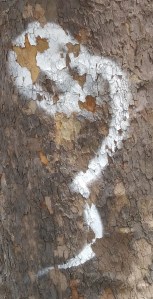
— Text(s) and photograph by William Eaton. Please note that the photo was taken along the left bank of the Seine one day in June 2024. It may be that the unknown person who spray-painted the tree bark with white had himself or herself conceived of this art work more or less as the photograph here presents it. Or it may be that I, the photographer, saw something that the spray painter did not have in mind, or that changes in the bark created.
 montaigbakhtinian