English followed by une version en français y una versión en español. There is also a note, in English only, regarding immigration and other matters.
I note here, that a few weeks after the present piece’s publication, page 1 of Le Figaro and its lead editorial proclaimed the rupture of the longstanding alliance between the United States and Europe. “L’Américain [Trump] fait le jeu d’un tsar convaincu du déclin inéluctable de l’Occident démocratique et capitaliste”. (Trump is acting like a czar convinced of the inevitable decline of the democratic, capitalist West.)
Another sign of the Trump Administration’s and the United States’s weakness. When the US was at the height of its power, this was in no small part because of its particular alliance with Europe which allowed the US to hold economic and military sway over the wealthy West. And at the beginning of this period, from the mid 1940s to the early 1970s, Westerners of most every social class enjoyed what was perhaps the greatest economic boom in world history.
As de Tocqueville reportedly said to his colleagues at the onset of the 1848 revolution: “Vous vous réjouissez de ce que le ministère est renversé; mais n’apercevez-vous pas que c’est le pouvoir lui-même qui est à terre?” You are delighted that the government has been overthrown, but don’t you see that power itself has been brought to its knees? (Alexis de Tocqueville, Souvenirs.)
The soon-to-be-mentioned 2017 limerick series was published in four iterations:
- Pence, Trump, Comey, Mueller, Capitalism — The Limericks
- The Limericks, Part II (Injustice, Trump, Illness, Poetry)
- The Limericks, Part III (Animals, Capitalism, the News, First Impressions)
- The Limericks, Part IV (No nation on Earth has an interest in seeing this band of criminals)
English
Trumperie, Versailles, Unintended Consequences
 With the lengthy exception of my 2017 limerick series, I try to avoid commenting directly on superficial political struggles. Yet I offer the following in the hopes that it might—in however odd a way—calm readers dazed and disturbed by the current turmoil in Washington and elsewhere.
In Paris-Babel, his excellent history of the French language, the Sorbonne professor Gilles Siouffi notes how in 1649 Louis XIV (then 10 years old) had to flee to the countryside to escape rebellious opponents of his regime (“la Fronde parlementaire”). Another story is that Louis XIV and his brother were first sent to Versailles to escape a smallpox epidemic. In either case, Louis, or his handlers, had become afraid of Paris, its diseases and rebelliousness. From one perspective, Versailles was a magnificent attempt by the government to turn its back on its weaknesses and fears.
And, Professor Siouffi goes on to suggest, in the resulting competition of court (Versailles) vs. city (Paris), Paris had the upper hand. Paris was where most people with money wanted to be. “Et l’éloignement physique de la Cour par rapport à la Ville ainsi que la divergence entre les conceptions traditionalistes du roi et l’évolution des mœurs finiront par peser sur le degré d’acceptation de la monarchie par la population.” (And, in the end, the physical distance of the Court from the City, as well as the divergence between the King’s time-worn views and the nascent ways of life, undermined public acceptance of the monarchy.)
So then the French Revolution becomes an inevitable consequence. Eventually the power of the city, of the bourgeoisie, had to claim the status it could only continue to gain in the wake of royalty’s fearful retreat. And the cost of the charade—Versailles et al.—helped bankrupt the monarchy and thus render it obsolete. And, perhaps more significantly, it reinforced the schism between the French government and French business. In Charles Wilson’s economic history of seventeenth century England, he notes that in England “The geographic proximity of Court and City might be a marriage of convenience that led to many quarrels, but at least it ensured that ‘trade’ had a voice in public affairs.”
In addition to their innate interest, these historical bits offer a way of viewing some of the lurches of the Trump administration in the United States. Trumpery is in part an attempt to regain a power and status for white male Americans that has been lost in the midst of globalization and dramatic changes in the economic roles and status of women. It is an attempt, too, to deny the need for dramatic changes in our way of life in order to reduce the degradation of the environment.
It is just a matter of time until the weaknesses underlying these trumped-up attempts are exposed, until the environmental catastrophe holds sway, and women and other nations further concretize the power and status they continue to gain in the global economy. And until the demand for more working-age adults make pro-immigration policies essential (both in the United States and in Europe).
Was the French transition from the ancien régime to a bourgeois republic quick, peaceful or complete? No. Did some such transition, in one form or another, become inevitable? Yes.
Cf. Martin Luther King, Where Do We Go from Here: Chaos or Community? (Beacon Press, 1967): “The inevitable counterrevolution that succeeds every period of progress is taking place.” And: “. . . men long regarded as political clowns [have] become governors or only narrowly missed election, their magic achieved with a “witches’ ” brew of bigotry, prejudice, half-truths and whole lies.”
Immigration (and other matters)
The day of the present piece’s publication, The Guardian published two stories that highlighted the economic non-viability of anti-immigration policies (to say nothing of the accompanying racist rhetoric and violence):
- How Spain’s radically different approach to migration helped its economy soar: As immigration has increased, GDP has surged and unemployment has fallen to lowest level since 2008.
- Visualised: Europe’s population crisis. A noter: the chart offered in this article suggests that, from here to the end of the twenty-first century, approximately one-third of the population of European countries could be coming from recent immigrants. An English version of a Le monde article (aussi disponible en Français) states: “In 1930, France had the highest rate of foreigners in the world, and some 40 years later, in 1975, the proportion of foreign-born residents in France was more than 12%, compared with less than 5% on the other side of the Atlantic.” This is far from 33 percent.
A late eighteenth-century survey proposed that 6 million French citizens (out of a total of 28 million) did not speak a word of French, and that another 6 million or so French people could not hold a conversation in French. Nonetheless, it seems legitimate to wonder how much of whatever may be left of traditional European cultures and forms of government would be retained in a country in which recent immigrants made up one-third of the population. And this when dramatic climate changes will also be altering ways of life.
Re the work of historians: There are those who have proposed that a period of history can’t be fully understood unless one considers the other ways things might have turned out. This strikes me as an easier thing to say than to do. For example, are we to imagine that the young Louis XIV’s team could have, rather than fleeing Paris, reached a compromise with la Fronde, and established then and there, in Paris, some version of a constitutional monarchy?
Finally, this from Paul Johnson’s 2014 hagiographical Eisenhower: A Life:
The United States at midcentury was . . . the largest petroleum producer in the world and supplied more oil than the rest of the world’s nations together. It harvested one third of the world’s grain and half its cotton. It was the world’s largest producer of phosphates, iron ore, zinc, lead, copper, salt and precious metals, including uranium. It had 90 percent of the world’s natural gas production. In metals, the United States outproduced the combined output of Germany, the USSR, Venezuela, Japan, France, Iran, Poland, Britain, the Netherlands, India, Burma and Belgium. Its production of minerals was four times that of the second largest producer, the Soviet Union, and larger than the combined output of the seven major producers. Almost half of the world’s manufactured goods came from the United States. Between 1940 and 1945, the American gross national product doubled, . . .
From this perspective, one might say that MAGA Trumpery is just the sad culmination of the long decline of the United States from the power it enjoyed at the end of the Second World War.
Français
De la Trumperie, Versailles, conséquences inattendues
 À l’exception de ma série de limericks de 2017, j’essaie d’éviter de commenter directement les luttes politiques superficielles. Pourtant, je propose ce qui suit dans l’espoir qu’il puisse – même si étrangement – apaiser les lecteurs hébétés et perturbés par l’agitation actuelle à Washington et ailleurs.
Dans Paris-Babel, son excellente histoire de la langue française, le professeur de la Sorbonne Gilles Siouffi raconte comment, en 1649, Louis XIV (alors 10 ans) a dû se réfugier à la campagne pour échapper aux opposants rebelles à son régime (« la Fronde parlementaire »). Une autre histoire raconte que Louis XIV et son frère furent d’abord envoyés à Versailles pour échapper à une épidémie de variole. Dans un cas comme dans l’autre, Louis, ou ses conseillers, avaient été effrayés par Paris, de ses maladies et de sa rébellion. D’un certain point de vue, Versailles a donc été une magnifique tentative du gouvernement de tourner le dos à ses faiblesses et à ses peurs.
Et, poursuit le professeur Siouffi, dans la compétition qui en résulte entre la cour (Versailles) et la ville (Paris), c’est Paris qui l’emporte. C’est à Paris que la plupart des gens fortunés voulaient se rendre. “Et l’éloignement physique de la Cour par rapport à la Ville ainsi que la divergence entre les conceptions traditionalistes du roi et l’évolution des mœurs finiront par peser sur le degré d’acceptation de la monarchie par la population.”
La Révolution française devient alors une conséquence inévitable. Finalement, le pouvoir de la ville, de la bourgeoisie, a dû revendiquer le statut qu’il ne pouvait que continuer à gagner dans le sillage de la retraite craintive de la royauté. Et le coût de la charade – Versailles et ces spectacles – a contribué à ruiner la monarchie et donc à la rendre obsolète. Et, peut-être plus important encore, elle a renforcé le schisme entre le gouvernement français et les entreprises françaises. Dans une histoire économique de l’Angleterre du XVIIe siècle, Charles Wilson note que la proximité géographique de la Cour et de la Cité en Angleterre, peut être un mariage de convenance qui a conduit à de nombreuses querelles, mais elle a au moins favorisé l’expression du commerce dans les affaires publiques.
Outre leur intérêt inné, ces bribes d’histoire offrent une manière de voir certaines des embardées de l’administration Trump aux États-Unis. La Trumperie est en partie une tentative de reconquérir du pouvoir et du statut des hommes blancs américains, perdus au milieu de la mondialisation et des changements spectaculaires dans les rôles économiques et le statut des femmes. Elle cherche aussi à nier la nécessité d’apporter des changements radicaux à notre mode de vie afin de réduire la dégradation de l’environnement.
Ce n’est qu’une question de temps avant que les faiblesses sous-jacentes à ces tentatives ne soient révélées, avant que la catastrophe environnementale ne s’impose et que les femmes et les autres nations ne concrétisent davantage le pouvoir et le statut qu’elles continuent de gagner dans l’économie mondiale. Et jusqu’à ce que la demande d’un plus grand nombre d’adultes en âge de travailler rende essentielles les politiques pro-immigration (tant aux États-Unis qu’en Europe).
La transition française de l’ancien régime à une république bourgeoise a-t-elle été rapide, pacifique ou complète ? Non. Une telle transition, sous une forme ou une autre, est-elle devenue inévitable ?Oui.
Cf. Martin Luther King, Where Do We Go from Here: Chaos or Community? (Beacon Press, 1967): « L’inévitable contre-révolution qui succède à chaque période de progrès est en train de se produire. » Et : « Des hommes longtemps considérés comme des clowns politiques sont devenus gouverneurs ou ont manqué de peu d’être élus, leur magie ayant été obtenue grâce à un mélange de bigoterie, de préjugés, de demi-vérités et de mensonges. »
Español
El Trumpismo, Versailles, Consecuencias Imprevistas
 Con la larga excepción de mi serie de limericks de 2017, intento evitar comentar directamente las luchas políticas superficiales. Sin embargo, ofrezco lo siguiente con la esperanza de que pueda – aunque curiosamente- calmar a los lectores aturdidos y perturbados por la agitación actual en Washington y en otros lugares.
En Paris-Babel, su excelente historia de la lengua francesa, el profesor de la Sorbona Gilles Siouffi señala cómo en 1649 Luis XIV (que tenía 10 años) tuvo que huir al campo para escapar de los opositores rebeldes a su régimen («la Fronde parlementaire»). Otra historia cuenta que Luis XIV y su hermano fueron enviados primero a Versalles para escapar de una epidemia de viruela. En cualquier caso, Luis, o sus superiores, temían París, sus enfermedades y su rebeldía. Desde una perspectiva, Versalles fue un magnífico intento del gobierno de dar la espalda a sus debilidades y temores.
Y, según el profesor Siouffi, en la competición entre la corte (Versalles) y la ciudad (París), París llevaba las de ganar. París era donde la mayoría de la gente con dinero quería estar. “Et l’éloignement physique de la Cour par rapport à la Ville ainsi que la divergence entre les conceptions traditionalistes du roi et l’évolution des mœurs finiront par peser sur le degré d’acceptation de la monarchie par la population.” (Y, al final, la distancia física de la Corte con respecto a la Ciudad, así como la divergencia entre las opiniones tradicionalistas del Rey, y los modos de vida nacientes, minaron la aceptación pública de la monarquía.)
Así que la Revolución Francesa se convierte en una consecuencia inevitable. Al final, el poder de la ciudad, de la burguesía, tuvo que reclamar el estatus que sólo podía seguir ganando tras la temerosa retirada de la realeza. Y el coste de la farsa – Versalles y sus espectáculos- contribuyó a la bancarrota de la monarquía y, por tanto, a dejarla obsoleta. Y, lo que tal vez sea más significativo, reforzó el cisma entre el gobierno francés y las empresas francesas. En una historia económica de la Inglaterra del siglo XVII, Charles Wilson señala que en Inglaterra la proximidad geográfica de la Corte y la Ciudad podría ser un matrimonio de conveniencia que dio lugar a muchos conflictos, pero al menos aseguró que el comercio tenía voz en los asuntos públicos.
Además de su interés innato, estos retazos históricos ofrecen una forma de ver algunos de los bandazos de la administración Trump en Estados Unidos. El Trumpismo es, en parte, un intento de recuperar un poder y un estatus para los hombres blancos estadounidenses que se ha perdido en medio de la globalización y los cambios espectaculares en las funciones económicas y el estatus de las mujeres. Es un intento, también, de negar la necesidad de cambios drásticos en nuestro modo de vida para reducir la degradación del medio ambiente.
Es sólo cuestión de tiempo hasta que se pongan al descubierto las debilidades subyacentes a estos intentos, hasta que la catástrofe medioambiental se imponga y las mujeres y otras naciones concreten aún más el poder y el estatus que siguen ganando en la economía mundial. Y hasta que la demanda de más adultos en edad de trabajar haga imprescindibles las políticas favorables a la inmigración (tanto en Estados Unidos como en Europa).
¿Fue rápida, pacífica o completa la transición francesa del ancien régime a una república burguesa? No. ¿Fue inevitable dicha transición, de una forma u otra? Sí.
Cf. Martin Luther King, Where Do We Go from Here: Chaos or Community? (Beacon Press, 1967): «Se está produciendo la inevitable contrarrevolución que sucede a todo período de progreso». Y: «. . . hombres considerados durante mucho tiempo como payasos políticos [se han] convertido en gobernantes o han perdido las elecciones por muy poco, su magia lograda con un brebaje ‘de brujas’ de fanatismo, prejuicios, medias verdades y mentiras enteras».
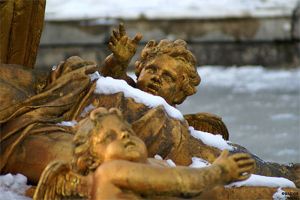
— Text(s) and lead (impressionistic) photograph by William Eaton. The other two photos are of le Bassin des Enfants à Versailles. It is not apparent who took the first of these; the second, with snow, in the Spanish section, is by Christian Matheus.
Among Eaton’s books: Art, Sex, Politics, a collection of essays (Serving House Books, 2017).
 montaigbakhtinian