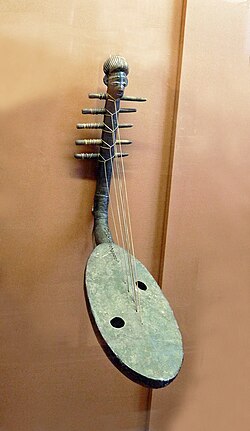
English followed by une version en français y una versión en español. As a kind of counterpoint to this poem I have appended far below a poem from central Africa. A song or chant it might better be called; the photograph featured in this post is of a Zande harp, such as the Nzakara poets of central Africa played while declaiming their texts.
The invocation comes from a 1907 speech of US President Theodore Roosevelt:
Many men of large wealth have been guilty of conduct which from the moral standpoint is criminal, and their misdeeds are to a peculiar degree reprehensible, because those committing them have no excuse of want, of poverty, of weakness and ignorance to offer as partial atonement.
I note, too, that this could have been yet another opportunity to quote Jonah’s discussion with God in the Old Testament. But this was just done last week in You couldn’t get them to vote for health.
As regards the acronyms in the English and French versions of these poems: ROI = return on investment and OPA = offre publique d’acquisition (une opération lancée pour acheter des titres d’une société cotée en bourse).
English
The thieves in and around Washington, Wall Street, the West Coast…
The thieves in and around Washington, Wall Street, the West Coast…
At the least they’re stealing billions
And covering their thievery by attacking others so much poorer
Or so much weaker than they are
While me, I’m playing tennis in the lengthening spring sun
The thieves in and around Washington, Wall Street, the West Coast…
They are enjoying the euphoria that comes when you feel
The rules – not even mortality
Nothing applies to you
I spend hours at the piano trying to turn notes into music, coordinate my hands
The thieves in and around Washington, Wall Street, the West Coast…
They’ve been trained to think that if they should ever stop conniving
There could be prosecutions, regulations; bankruptcy, hostile takeovers
Declining ROI
Mornings I’m wondering: a croissant stuffed with delicious butter or one still oven-warm?
The thieves in and around here and there
They’re so much smarter and tougher and richer
And they have so much fun playing tyrants and
Uber-intelligent thieves
And me? I’ve had to find a shady bench in a park so I could type these words into my laptop
And just in front of me there’s a sandbox with a child savoring the plastic shovel he’s slowly turning in his mouth
Français
Les malfrats à Washington, à Wall Street, sur la côte ouest…
Les malfrats de Washington, à Wall Street, sur la côte ouest…
Au moins ils volent des milliards
Et couvrent leur vol en s’attaquant à d’autres bien plus pauvres
Ou bien plus faibles qu’eux
Je pratique le tennis sous le soleil du printemps
Les malfrats de Washington, à Wall Street, sur la côte ouest…
Ils profitent de l’euphorie qui survient
Lorsque vous ressentez que les règles – pas même la mortalité
Rien ne s’applique à vous
Je passe des heures au piano, à chercher la musique dans les notes, à m’entraîner avec les mains
Les malfrats de Washington, à Wall Street, sur la côte ouest…
Ils sont entraînés à penser que s’ils cessent de malfrater ils s’exposent à des poursuites
A des réglementations, des faillites, des OPA hostiles
A un déclin de la rentabilité des capitaux investis
Le matin, je m’interroge : un croissant fourré de beurre Charentes-Poitou ou tout juste sorti du four ?
Les malfrats d’ici et d’ailleurs
Sont tellement plus intelligents, plus forts et plus riches que moi
Et ils s’amusent tellement à jouer les tyrans
Des voleurs uber intelligents
Et moi ? J’ai dû trouver un banc ombragé dans un parc pour pouvoir taper ces mots sur mon portable
Et juste devant moi, il y a un bac à sable avec un enfant qui savoure la pelle en plastique qu’il tourne lentement dans sa bouche
Español
Los ladrones de Washington, de Wall Street, de la West Coast…
Los ladrones de Washington, de Wall Street, de la West Coast…
Al menos están robando miles de millones
y encubren sus robos atacando a otros mucho más pobres
o más débiles que ellos
Juego al tenis bajo el sol primaveral
Los ladrones de Washington, de Wall Street, de la West Coast…
Están disfrutando de la euforia que se produce
cuando sientes que las reglas -¡ni siquiera la mortalidad!
nada se te aplican
Me paso horas al piano intentando convertir notas en música, coordinar mis manos
Los ladrones de Washington, de Wall Street, de la West Coast…
Han sido entrenados para pensar que si paran de robar
estarán expuestos a demandas, reglamentos, quiebras, adquisiciones hostiles
una disminución de la rentabilidad del capital invertido
Y yo, cada mañana tengo que decidir si quiero un cruasán relleno de mantequilla sabrosa o uno aún caliente

Los ladrones de aquí y de allá
son mucho más listos, duros y ricos que yo
y se divierten tanto jugando tiranos
ladrones Uber-inteligentes
¿Y yo? Tuve que buscar un banco a la sombra en un parque para poder teclear estas palabras en mi portátil
y justo delante de mí hay un arenero con un niño saboreando la pala de plástico que está girando lentamente en su boca
— Poem(s) by William Eaton. The featured image is of a Zande harp, in the collection of le Musée royal de l’Afrique centrale, Brussels.
A poem from central Africa
 While composing the above poem I was walking up la rue Claude Bernard in Paris, and at the top of the hill there is a little used bookstore, La Manne, that I quite like. In a bin along the sidewalk I found the first volume of Poètes nzakara, edited by a French ethnologue, Eric de Dampierre. Nzakara, Wikipedia tells me, is a Zande language spoken in parts of the Central African Republic and the Democratic Republic of the Congo. There are now approximately 50,000 native speakers.
I find myself reminded, if but vaguely, of the Brazilian indigenous people or peoples who Lévi-Strauss studied in the 1930s. They were called primitive, but in at least one text Lévi-Strauss stressed that it was not that their culture had not developed; rather, more powerful outsiders had reduced them to their impoverished state.
In the introduction to his book, de Dampierre states that for centuries the Nzakara had been a great people. Until the arrival of outsiders—first Arabs (or so-called Arabes) seeking slaves, and then Belgians and French people seeking ivory. In more sovereign times, every year the Nzakara would attack their neighbors to get male slaves to sell and women to reproduce with. The Nzakara women themselves were sorts of “princesses,” more focused on ruling than on having children.
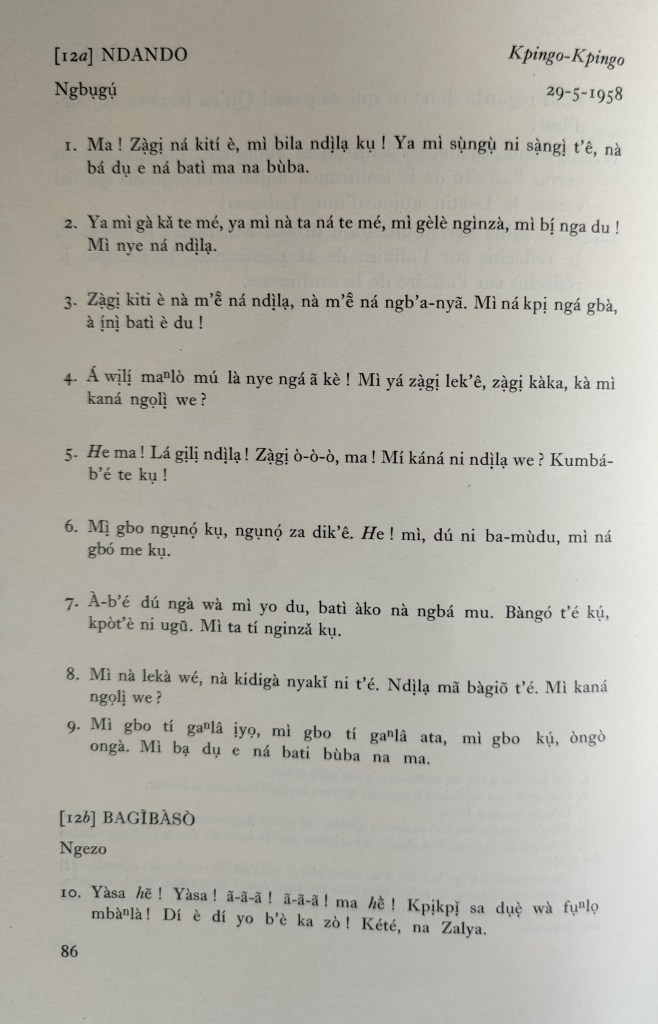
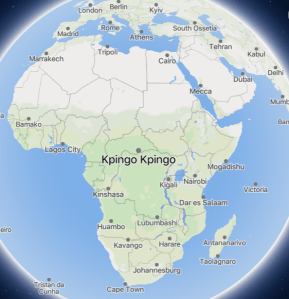 That said, the following poem (or chant or song), recorded in 1958 in the village of Kpingo-Kpingo (map at right), is from a less glorious period in Nzakara life. The title would seem to be Ngbugú (with dots under the two u’s), but this word is not translated. Although in the poem a woman is speaking, Ndando, the poet, was a man.
An image of de Dampierre’s transcription of Ndando’s poem appears after de Dampierre’s French translation and my own English version.
De Dampierre’s French translation
1. Ma mère ! Le destin est sur moi, je me suis plaint en vain de mes malheurs. Je dis, je me tiens seule par devers moi.
2. Je dis, je suis venue dans ce village et je me promène dans ce village, je cherche de l’argent et n’en vois pas. Je demeure dans la malheur !
3. Le destin est sur moi et me dépose dans le malheur, me dépose dans la gueule des animaux féroces. Si je meurs demain, on n’en saura pas l’endroit.
4. Si du moins cette petite fille était restée là [en vie]. Je dis que le destin dispose bien de moi, le destin refuse ; mais que ferai-je maintenant ?
5. Eh, ma mère ! Encore un jour de malheur en plus ! Toujours le destin, ma mère ! Quoi faire du malheur ? Je n’ai pas de mari.
6. Je pleure de chagrin en vain, le chagrin est en train de m’envahir. Eh, moi, qui suis jeune, je m’afflige et rien ne vient !
7. Mes compagnons ne sont pas comme moi, ils sont mieux partagés. Mes vêtements ne sont pas à moi, mon corps est desséché. En vain j’ai cherché de l’argent.
8. J’allume le feu et vais casser moi-même le bois mort. La souffrance me laisse des douleurs d’estomac. Que ferai-je ?
9. J’ai pleuré deux ans, j’ai pleuré trois ans, j’ai pleuré en vain, je me suis tu. Je réfléchis à l’endroit où demeuraient mon père et ma mère.
My English version, from the French
1. O mother! Fate weighs on me. I weep in vain. I’m telling you, I stand here alone, in front of myself.
2. I’m telling you, I came to this village and I walk around this village and I look for money and don’t see any. I live in unhappiness.
3. Fate weighs on me. It leaves me unfortunate. It leaves me in the jaws of the beasts. If I die tomorrow, no one will know where.
4. If only the little girl remained. I’m telling you, fate does what it wishes. And it rejects me. What to do?
5. Hey mother! Another bad day. Fate is inescapable, mother. What am I to do with this misfortune? I don’t have a husband.
6. I cry in vain. Grief is overtaking me. Hey, I, me, who am young, I grieve and nothing comes!
7. My neighbors are not like me. They’re better provided for. My clothes are not mine. My body has withered. In vain I’ve looked for money.
8. I light the fire and myself chop up the rotting logs. Suffering has given me stomach pains. What to do?
9. I cried for two years. I cried for three years. I cried in vain and then shut up. I’m trying to remember where my father and mother lived.
 montaigbakhtinian