English followed by une version en français y una versión en español. (All versions as revised in September 2025.) There is also a Notes section in English.
A French painter once said something about how at some point it’s no longer a matter of what you may have wanted to paint (or say); you have to complete the painting that’s on your canvas. That was certainly the case here.
English
One note
One day in winter a friend too far away,
A pianist who was switching to violin,
Messaged about her continuing struggle
To get any note to sound as she’d like.
And the man, returning to his piano bench,
He had his ideas about what his friend meant,
And how, not for nothing, our difficult tunes . . .
And all the different ways desire’s kept away.
From a shelf he snatched a poetry book,
“Modern” – which ended before his birth.
And trying to decipher what others meant –
Here too he found struggle, messages self-contained.
Strong fingers, he mused, and a stubborn mind –
And concentrating alone, long hours at a time, . . .
Otherwise one might live in quite another way
Than my friend too far away, or this life here of mine.
Notes
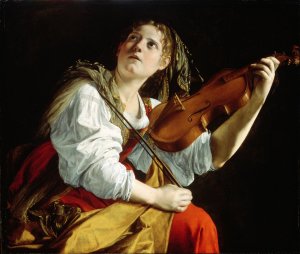
The featured image is Orazio Gentileschi’s 1612 Giovane Donna con un Violino. And below one may find images of Reginald Gray’s 1972 portrait of Alfred Schnittke and of Ferdinand Schimon’s 1819 portrait of Beethoven.
The use of portraits of Beethoven and Schnittke is a result of two excellent recent concerts here in Paris. The first, at Les Rendez-vous d’Ailleurs, involved a discussion and performance of the “Hammerklavier,” Beethoven’s most technically challenging piano composition. The commentary was provided by the expert Jean-François Boukobza and the music by his cousin, the pianist Laurent Boukobza. This concert was part of an ongoing series in which Laurent is performing the thirty-two piano sonatas of Beethoven.
The second excellent concert was by two young French musicians: cellist Adrienne Auclair and pianist Adrien Irankhah (who form the Duo Pulsation). The concert was held at the Schola Cantorum and sponsored by the Piano Con Moto organization. In the terminology of my poem, both Madame Auclair and Monsieur Irankhah may be said to have “strong fingers.” Or better, beautiful music comes readily and steadily to the tips of their fingers. They played technically and aurally challenging pieces by Schnittke and Shostakovich, but their mastery and their engagement with these pieces overcame any resistance a listener might have.
The poetry anthology alluded to: Twelve Modern Poets, edited by Artur Lundkvist (Zephyr Books, The Continental Book Company AB, Stockholm/London, 1946).
Français
Une seule note
Un jour d’hiver, une amie trop loin,
Une pianiste qui s’est mise au violon,
« Si seulement », elle l’écrit : « Une seule note,
Je pouvais la faire sonner comme elle devrait. »
 Et l’homme, de retour à son piano,
Il a ses idées sur ce qu’elle voulait dire,
Et qu’ils ne sont pas pour rien, nos airs difficiles –
La lutte doit être forte pour contrer le désir.
Il arrache d’une étagère un livre de poésie
« Moderne » (bien antérieur à sa naissance).
Mais il essaie de déchiffrer ces pages jaunies,
Et là aussi, il trouve lutte, des messages autonomes.
Plus que des doigts forts, il faut être têtu
Et se concentrer seul, de longues heures durant.
Sinon, il se dit, on pourrait vivre, peut-être prospérer
D’une toute autre manière que mon amie lointain,
Ou que cette drôle de vie
Qui est la mienne.
Español
Una sola nota
Un día de invierno, una amiga lejana,
una pianista que se ha pasado al violín,
«Si tan solo», escribió, «pude conseguir
que una sola nota sonara como debería.»
Y el hombre, de vuelta a su piano,
tenía ideas sobre lo que ella decía,
y como nuestras cantinelas difíciles
nos ayudan a guardar el deseo lejos.

Cogió un libro de poesía «moderna»
(mucho antes de su nacimiento).
Intenta descifrar las frases amarillentas,
Aquí también hubo lucha, mensajes autónomos.
Dedos fuertes, él reflexionó, y una mente obstinada…
Y concentrarse a solas, horas tras horas…
Si no uno podría vivir de una forma distinta
a la de mi amiga, o de esa vida mía.
— Poem(s) by William Eaton.

 montaigbakhtinian