According to the Talmud, “Yom Kippur atones for those who repent and does not atone for those who do not repent”.
We floss, Lord
We floss, Lord, we watch our weight.
Our underwear is new and clean.
Our hair is brushed and shaved and colored and waxed,
Our nails by others weekly done –
Pilates, yoga, mindfulness.
When the service is good, Lord,
We do try to give a little larger tips,
And we try to remember to recycle.
But, You know, one thing we say is “Shit, we’re late!”
And, “There’s only so much one person can do.”
And of course, you know too, how many friends we have,
And how our phones are always on
And how, when we’re not sure if we’re truly desired,
When it looks as if another’s smile, sales or contacts are preferred,
When we’re not sure we are desired, Lord, or not by the right people,
We turn away.
We can always say our phones were off or misplaced or
“You won’t believe what happened!”
You see, God of pardon, we are the special ones,
For us there’s always a table free.
It’s us who get to say yes or no.
And, oh sure, at times we exceed the speed limit,
We run red lights, we text and drive at times,
When drunk, or more…
(We prefer to keep secret the X-rated things).
Weekend mornings are for forgetting.
We want to feel lucky, Lord,
We want to feel bright as a beach in summer, plus another beach farther south in the winter,
With that special warm glow that comes from being somewhere you can only be
If you have money.
Everything – the songs, the movies, the big events – has happened since we were born.
But this doesn’t mean we haven’t heard of the Holocaust.
When we’re channel surfing on the couch with our kids, sometimes we pause on a docudrama,
If our kids don’t object too loudly.
And there was that year, dear God, we gave money to UNICEF.
Oh the people exploited, the poor animals oppressed,
To say nothing of some of our friends, buried at their desks –
Would you have us feel more guilty,
Take more classes, get more massages,
Would you have us worry more than we already do?
We’re human beings, Lord
So much that is good we find within,
And so much that is bad we can see in the world around us,
In other countries, other neighborhoods,
In people who don’t share our politics, our taste in clothes, our semi-religious beliefs.
So now it comes again, the day of atonement,
Which sin would you have us confess?
We really do look up to our parents and grandparents,
And make fun of their cluelessness.
As for ourselves, our special group,
We will always be who we are, Lord,
Eating the foods that people like us are eating.
And something like ditto for the people we hire, and fire, our children to teach.
It’s not that we have not made mistakes, Lord,
We know we have.
It’s not that we have not been catty and cruel,
We know we have.
We keep lists on paper
And in our heads lists of who and what have held us back.
And then of course there are the leaders and organizations who are really responsible,
And all the wonderful things we enjoy that others do not.
Someone to remove the stubborn spots from our blouses and panties,
To take public transportation, fight with the police,
Wait in lines at the airport, emergency wards.
Have we forgotten to thank you for those others, Lord?
Of course we have done unto them,
And unto our friends, too, by the way.
At times it’s been precious little,
At times a bit too much
Pardon us, forgive us, atone for us
This is the best we can do.
This is the maximum effort we’re prepared to make.
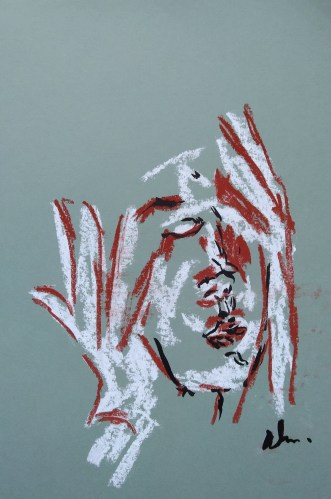
— Poem and drawing by William Eaton..
Please note that the poem was drafted in 2009, posted on Montaigbakhtinian in 2012, and then revised in 2023, 2024, 2025 . . . In 2023 a new image was used.
And at some moment in these years I came across these lines in T.S. Eliot’s 1935 Murder in the Cathedral:
We have not been happy, my Lord, we have not been too happy.
We are not ignorant women, we know what we must expect and not expect.
We know of oppression and torture,
We know of extortion and violence,
Destitution, disease,
The old without fire in winter,
The child without milk in summer,
Our labour taken away from us,
Our sins made heavier upon us.
Could these lines have been somewhere in my unconscious as I was working on “We floss, Lord”?
 Btw
Btw
Some stats and some news stumbled upon in September 2012.
(1) During the German Occupation of France, between 1940 and 1944, hundreds of thousands of letters were sent to the police or to the Gestapo denouncing residents of France as Jews or communists or De Gaulle supporters—enemies of the state of one kind or another. According to the French historian Lauent Joly (La délation dans la France des années noires, Editions Perrin, 2012), in most every case the motivation for the letter was personal rather than political. Simply put, people were attacking neighbors, competitors, spouses—people they didn’t like or who had something they coveted. All this was encouraged by the government under what in the post-9/11-era could be called “if you see something, say something.”
(2) In Australia, apparently, the colloquial verb is “to dob” or “to dob in”: to tell on someone. And indeed the government has a set up a “dob-in line” for any who may wish to report on tourists whose visas have expired, or on people working without the proper papers, or on those who would seem to have married for love of being able to stay legally in Australia. This is ironic if also not surprising given the waves of convicts, gold diggers, post-World-War-II refugees and Ten Pound Poms (British subjects charged only ten pounds sterling for the fare): people who have found homes for themselves on the island sometime in the past 250 years. In any case, the French example calls attention to one of the perhaps little-regarded benefits of the dob-in line (which has been getting more than a thousand calls a month): It has the capacity to provide locals a convenient means of making life miserable for neighbors, competitors and spouses—envied, feared or simply disliked.
Francophones may be interested in the brief interview with M. Joly published in February 2012 in the Swiss newspaper La Liberté: “Quand la délation empoisonnait la France.” This is the source of the photograph of envelopes appearing above. Official details regarding the dob-in line may be found at www.immi.gov.au/contacts/dob-in.
 montaigbakhtinian