Summer is for sunlight and lighter poetry? Two ditties here. As regards the first—le français followed by a version in English y una versión en español—it was inspired by the fact that in English “Biles” and “Weil” would more or less rhyme, as in French, “Weil” and “veille.” (Simone Weil, 1909–1943, was a French philosopher, mystic, and political activist whose life and work remain much better known in France than, say, in the United States. It has been said that her asceticism may have led to her early death.)
As for the second, beach & love poem—in English, en français y en español—might it be self-explanatory?
Please note: Not for the first time I found re-reading much later the original poems… Inspired both embarrassment and overhauling. Herewith the revised versions of June 2025.
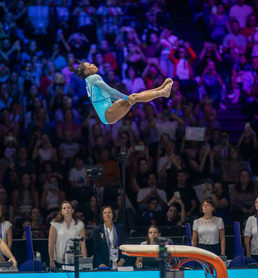
De la philosophie tout à fait olympienne

On a invité votre Simone Biles
À remplacer notre Simone Weil,
Puisque elle offrait plus de smiles
Et n’était pas aussi vieille.
Et pour ce qui reste philosophique
(Bonjour Platon, Kant, le Christ),
Quand Simone virevolte dans l’air,
Considérions les gymnosophistes !
Notes
Il peut être utile de savoir que “gymnosophe” – ou γυμνοσοφισταί (gymnosophistaí), c’est-à-dire les sages nus – était le nom donné par les Grecs anciens à certains philosophes indiens anciens qui poursuivaient l’ascétisme au point de considérer la nourriture et les vêtements comme nuisibles à la pureté de la pensée. Le mot grec γυμνός (gymnós) signifie nu, et σοφία (sophía) se traduit par « sagesse ».
Après avoir publié ce poème, je suis tombé sur un passage de Weil (extrait de La pesanteur et la grâce, 1947) :
Le mal imaginaire est romantique, varié, le mal réel morne, monotone, désertique, ennuyeux. Le bien imaginaire est ennuyeux ; le bien réel est toujours nouveau, merveilleux, enivrant.
Ainsi, suis-je poussé à proposer que les sauts de Simone Biles illustrent le « bien réel » ?
English
Olympian philosophy
We French invited Simone Biles
To replace our old Simone Weil.
New, American, she offered more smiles,
And her clothing, it had more style.
And as for beliefs that may persist,
From Germans, Greeks, religionists,
When the new Simone twirls the air,
We become gymnosophists.
Notes
 It may help to know that “gymnosophist”—or γυμνοσοφισταί (gymnosophistaí), i.e. naked wise men—was the name given by ancient Greeks to certain ancient Indian philosophers who pursued asceticism to the point of regarding food and clothing as detrimental to purity of thought. The Greek word γυμνός (gymnós) means naked, and σοφία (sophía) translates to “wisdom.”
After having published this poem, I happened upon a bit of Weil’s writing from La pesanteur et la grâce (Gravity and Grace, 1947):
Imaginary evil is romantic and varied; real evil is gloomy, monotonous, barren, boring. Imaginary good is boring, real good is always new, marvelous, intoxicating.
And so, do I now find myself pushed to propose that Simone Biles’s vaults exemplify the “real good”?
Español
Filosofía olímpica
Los franceses invitaron a Simone Biles
a sustituir a su Simone Weil.
Sonrió más, la americana,
y más elegante era su ropa.
Y por lo que queda filosófico,
de Platón, de Kant y de Cristo,
ver a Simone volar tan alto,
¡nos hacemos gimnosóficos!
Notas
Puede ser útil saber que “gimnosofista” -o γυμνοσοφισταί (gimnosofistaí), es decir, sabios desnudos- era el nombre que daban los antiguos griegos a ciertos filósofos indios de la antigüedad que seguían el ascetismo hasta el punto de considerar la comida y el vestido como perjudiciales para la pureza de pensamiento. La palabra griega γυμνός (gymnós) significa desnudo, y σοφία (sophía) se traduce por “sabiduría”.
Después de haber publicado este poema, me topé con un 1947 escrito de Weil de La pesanteur et la grâce (La gravedad y la gracia):
El mal imaginario es romántico y variado; el mal real es sombrío, monótono, estéril, aburrido. El bien imaginario es aburrido, el bien real es siempre nuevo, maravilloso, embriagador.
Así pues, ¿me veo ahora empujado a proponer que los saltos de Simone Biles ejemplifican el “bien real”?
English
The best poems are written at the beach
If only you were here, we’d be playing mini-golf.
Rebounding high on the trampoline!
Naked we’d be swimming far out to sea,
Touching only underwater, sight unseen.
Français
Les meilleurs poèmes sont écrits à la plage
Si seulement tu venais au mini-golf,
Ou pour sautais pieds nus sur le trampoline!
La mer nous baignerait sans rougir.
Oh, accorde-moi un faible soupir.
Español
Los mejores poemas se escriben en la playa
Si estuvieras aquí al lado del mar,
¡saltaríamos juntos en el trampolín!
Desnudos nos bañaríamos sin pudor
y bajo el agua podríamos tocar.
 — Poems and artwork (and photo at right) by William Eaton.
 montaigbakhtinian