Una traducción en español suivie par une traduction en français, and then the English original, by the Scottish poet Hugh MacDiarmid (1892–1978). Tenga en cuenta que las traducciones al francés y al español se revisaron en la primavera de 2023, bien après que des versions antérieures aient été publiées sur ce site.
The more I worked on these translations, the more MacDiarmid’s poem seemed to have something to say to us today, in these tempestuous times. (And our hearts go out to the Ukrainians.)
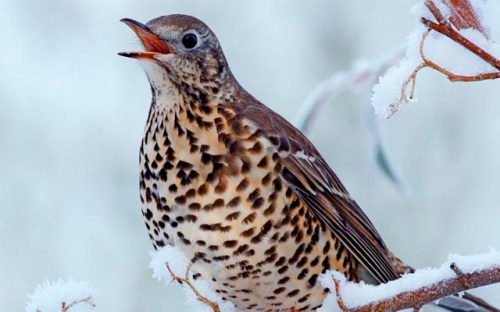
The bird of the poem, who MacDiarmid (né Christopher Murray Grieve) calls a “Storm-Cock,” is commonly called a Mistle Thrush, Turdus viscivorus, Zorzal Charlo, Grive draine. It is the largest songbird in the United Kingdom, and, as The folklore of the mistle thrush puts it: the bird “famously eschews the onset of inclement weather, raising a welcome voice even during squalls of snow.”
The poem speaks of a “distant red in the East.” At the time this may have referred, at least in part, to Soviet Russia—« la grande lueur à l’Est », the great light in the East. In 1935, MacDiarmid published the poem in a collection entitled Second Hymn to Lenin and Other Poems (1935). However, there is, alternatively, an English expression “Red sky at morning, sailors take warning.” Spanish and French versions include: « Cielo rojo mañanero, aviso para el marinero »; « Rouge le matin chagrin (ou la pluie est en chemin) ».
Readers may click on this link to hear the Mistle Thrush’s song. MacDiarmid suggests that the bird seems at times to be saying “Will I do it? Do it I will!” « ¿Lo haré? ¡Hazlo, lo haré! » Ou: « Vais-je le faire ? Je le ferai ! » But since the poet is referring not only to the possible meaning but also to the sound, this seemed untranslatable, and I left these words in English in both the Spanish and French versions.
Español
La canción del Zorzal, en la tormenta
Mi canción de hoy es la de un zorzal.
Cuando sopla el viento frío y la nieve
arremolina oculta hasta los copas, solo
su canto resuena en las calmas. ¡Que suelta el mío!
En la rama más alta de un fresno sin hojas,
se sienta erguido contra el cielo, observando
los campos blancos y, con su mirada boyante,
el bosque desnudo y el rojo del Este.
El pájaro tiene pocos motivos para cantar.
Por la escarcha las bayas han sido despulpadas
o comidas por animales más agresivos. Pero
aun así, a otro día de hambre, lanza su saludo.
Benditos los que tienen canciones que cantar
cuando los demás callan. Y aunque sea débil,
aunque solo le diga al silencio que alguien sigue
vivo y feliz, aunque en un árbol desnudo.
¿Y si son solo unas notas agitadas,
lanzadas sin arte, nada más que ruido?
Mucho vale su “Will I do it? Do it I will!”
cuando el resto no tiene nada que decir.
Français
La chanson du Grive, dans la tempête
Ma chanson d’aujourd’hui est celle d’une grive draine.
Quand souffle le vent froid et la neige battante
Cache la cime des arbres, seul son chant
Résonne dans les accalmies. Que le mien le suive !
Sur la plus haute brindille d’un frêne sans feuilles,
Il se tient, assez satisfait, tout droit contre le ciel.
Avec son œil vif toujours il surveille – les bois nus,
Le blanc des champs, le rouge lointain, mordant à l’Est.
L’oiseau a sûrement peu de raisons de chanter,
Même les fruits de baie – leur pulpe perdue au gel,
Ou mangés par d’autres plus agressifs. Pourtant,
À encore un jour affamé il lance son salut.
Sont bénis ceux qui trouvent un air à chanter
Quand d’autres se taisent. Et même s’il soit faible,
S’il ne dit qu’au silence que quelqu’un est encore
Vivant et heureux, bien que sur un arbre nu.
Et s’il ne s’agit que de quelques notes agitées,
Lancées sans art, sans rien que de bruit ?
Beaucoup valent son “Will I do it? Do it I will!”
Quand tous les autres ont si peu à dire.
English original
“The Storm-Cock’s Song,” by Hugh MacDiarmid
My song today is the storm-cock’s song.
When the cold winds blow and the driving snow
Hides the tree-tops, only his song rings out
In the lulls in the storm. So let mine go!
On the topmost twig of a leafless ash
He sits bolt upright against the sky
Surveying the white fields and the leafless woods
And distant red in the East with his buoyant eye.
Surely he has little enough cause to sing
When even the hedgerow berries are already pulped by the frost
Or eaten by other birds–yet along and aloft
To another hungry day his greeting is tossed.
Blessed are those who have songs to sing
When others are silent; poor song though it be,
Just a message to the silence that someone is still
Alive and glad, though on a naked tree.
What if it is only a few churning notes
Flung out in a loud and artless way?
His ‘Will I do it? Do it I will!’ is worth a lot
When the rest have nothing at all to say.
— Translations by William Eaton. Photo of the bird singing found on the Web, without attribution.
Closing note. Since I’ve already touched on the “red sky at morning” sayings, I would note this French saying regarding grives: “faute de grives on mange des merles” (ou: “à défaut de grives on mange des merles”). C’est-à-dire: Faute d’avoir ce que l’on souhaite, il faut se contenter de ce que l’on a. (If you don’t have what you want, you have to make do with what you have.)
 montaigbakhtinian
[…] seemed to belong on the American side. One example of the English approach is Hugh MacDiarmid’s The Storm-Cock’s Song, which I posted, along with my translations of it into French and Spanish, some months […]