English followed by une version en français y una versión en español. There is also, in English, a Note regarding Tiddlywinks.
You could misunderstand Brad
A poem for the new year
It was always rather odd with him,
What he would and wouldn’t do.
He wouldn’t eat potatoes
Until someone tied his shoes.
He had a thing for Tiddlywinks
Though the colors he misconstrued.
And, yes, he bathed in pickle juice
Somewhat oftener than you.
And next we heard, he’d run away;
We caught him on the news.
He’d invented a contraption
Young dictators overthrew.
He wanted, live, to prove its worth,
But the anchor, she eschewed.
And Brad’s tears copious flowed
After his mother aired her views.
Was it this that got him gardening?
Toenails were what he grew.
He was not like all the others,
You little knew what he’d do.
Note regarding Tiddlywinks (or Tiddleywinks)
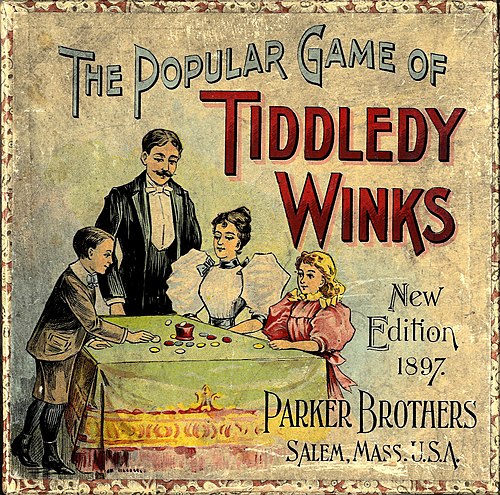
From Wikipedia: Tiddlywinks is a game played on a flat felt mat with sets of small discs called winks, a pot, which is the target, and a collection of squidgers, which are also discs. Players use a squidger (nowadays made of plastic) to shoot a wink into flight by flicking the squidger across the top of a wink and then over its edge, thereby propelling it into the air. The offensive objective of the game is to score points by sending your own winks into the pot. The defensive objective of the game is to prevent your opponents from potting their winks by squopping them: shooting your own winks to land on top of your opponents’ winks. As part of strategic gameplay, players often attempt to squop their opponents’ winks and develop, maintain and break up large piles of winks.
Français
Vous risquez de Roger mal comprendre
Un poème pour la nouvelle année
C’était toujours un peu bizarre,
Ce qu’il faisait et jamais.
Manger des pommes il refusait
Avec chaussures trop serrées.
Tandis que des cornichons,
Entourés de la moisissure,
Ceux-là, oui, certaines nuits,
L’ont fait se gondoler.
Et puis un jour – disparu ;
La police – prévenue.
Elle l’a trouvé aux informations
Avec trois quarts d’une hélice.
Muni de morve et de ce gadget,
Dictateurs jeunes, il allait évincer.
Et en direct il était prêt. . .
L’impact, tout le monde l’attendait. . .
Mais l’animatrice, en foulard en soie,
Au nez pâle et retroussé. . .
Et les larmes de notre Roger,
En chaleur et en quantité. . .
Voici sa mère en chaise roulante
Qui sous toutes les jupes,
Avec un sourire et des griffes rouge sang,
La clé USB traquait.
Est-ce cela qui l’a provoqué
De reconstruire son clapier ?
Il se démarquait, oui, de vos amis,
Et son destin, triste ou pas . .
On ne va pas le deviner.
Español
Puedes malinterpretar a Juan
Un poema para el año nuevo
Siempre fue un poco raro,
lo que haría y se negaría.
No podía comer manzanas
con los cordones apretados.
Mientras que los pepinillos
de moho gris cubiertos…
Y entonces se esfumó
sin dejar rastro alguno.
Y aunque seguimos llamando,
la policía no contestó.
(¿Habías saboteado una cosa
o se han ido a comer?)
Al final, en las noticias,
Sostenía un silbato turquesa.
Y armado con este artilugio,
se podría dictadores rechazar.
Y, en directo, estaba listo
su valía demostrar.
Pero la presentadora,
debajo de sus capas de maquillaje,
tenía una nariz tan pequeña
que las lágrimas de nuestro hombre
corrían copiosamente,
y su mamá apareció.
En las sombras de faldas buscaron,
pero el USB no lo encontraron.
¿Así que Juan comenzó a cavar
alrededor de su corazón?
No era como nosotros,
¿para quienes la vida…
es pan comido?
— Poem(s) by William Eaton.
Check out Eaton’s 2024 collection of poetry and prose: 4 billion eggs.

