English only, I’m afraid. Pour l’absence d’une version en français, je m’excuse auprès des lecteurs francophones. DeepL traduit bien et vite ; cependant, ce poème repose tellement dans des allusions . . . Y por la ausencia de una versión en español, pido disculpas a los lectores hispanohablantes. DeepL traduce bien y rápidamente; sin embargo, este poema descansa tanto en alusiones . . .
Well-watered were her buds, the long nights through
Things there were and services; though young, she knew.
Father large and lonely, prodigious will profuse.
“What,” she gasped, “will I be, containing all of you?”
Nothing, no one, came the response, dark nights through.
Swamps must be drained, green hollows plowed and used;
Nice how, all this effort, stumps and stones it loosed –
And then ignored: what matters are the fruits!
Just for her the hardness, sharp edges, deep roots.
Of lands equal strange, she read all the news:
Miners in those jungles, gold and silver pursued;
Pursued until they saw, splintered by their tools,
Gems and crystals brilliant, colored like a bruise.
Her ornaments were few; friends found them rude.
She had to make up lovers with such charms enthused.
Of ring no need, more linens to misuse.
Her diadem discovered, her hunger stroking wooed.
Her mind made lists – words not exactly true;
Words to tickle the ears, the devil to confuse,
Like funny body-part names children were to use,
While stinger bees for honey soft petals perused.
A cipher she invented, being clever too;
Decency and grammar she equally excused;
And those who knew the code: less than a few.
Most were left uncomfortable: to themselves ever true!
Well-watered were her buds, the long nights through.
Mortality awaited – her dead words to diffuse.
The green hills, dark hollows resounding with her tunes.
And all those girls abandoned, bleeding with the moon?
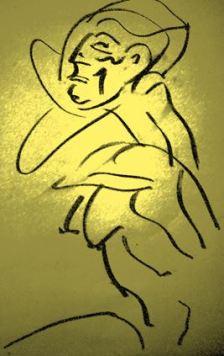
— Poem and drawings by William Eaton
The version originally posted, in July 2019, was substantially revised (or re-worded) in 2023.
More intellectual readers may be interested in my essay Dickinson’s Dying Tiger. I wrote that essay before reading Wendy K. Perriman’s A Wounded Deer: The Effects of Incest on the Life and Poetry of Emily Dickinson (Cambridge Scholars Press, 2006). This valuable book argues that Dickinson was an incest survivor, sexually abused by her father or her brother or perhaps both. I read this book because the poetry had already convinced me that Emily had had incestuous sex with one or both of these male relatives. (Though I would note that “incest survivor” relocates her nineteenth-century life in a more contemporary context. And, as Laura Kipnis observed in her 2017 Unwanted Advances: Sexual Paranoia Comes to Campus, we are now rather grotesquely conflating the Holocaust and sexual harassment.)
All this said, please note hat the poem above, though it touches on, does not seek to describe, accurately or inaccurately, Emily Dickinson’s life and work. Indeed, among my principal tasks: maintaining the life in a poem in which every line-ending rhymes with all the others. Cf. this comment made by T.S. Eliot to Cleanth Brooks about an explication which Brooks had undertaken of one of his poems: “Reading your essay made me feel . . . that I had been a great deal more ingenious than I had been aware of, because the conscious problems with which one is concerned in the actual writing are more those of a quasi-musical nature, in the arrangement of metric and pattern, than of a conscious exposition of ideas.” (As quoted in Paul Fussell, Poetic Meter & Poetic Form.)
 montaigbakhtinian