English followed by une première ébauche en français y un primer borrador en español.
Working on this dialogue I recalled not only i porcellini (the guinea pigs), but also textbooks that contain simple dialogues to help students learn foreign languages. But it would not be for me, a non-native speaker, to prepare le français o l’español for such a book. Thus the versions here are first drafts which I hope native speakers will help me improve some day.
I also recalled the American poet Robert Frost’s dramatic narratives and thus have included two passages from one of these toward the end of the present post. And then there are Spanish-English bitexts of two final stanzas from Gustavo Adolfo Béquer’s short “rimas.” For me, they share some feelings with those of my dialogue(s).
We might let some light in
 “Would this then be Paul’s email address?”
“Yes. . . . I’m sure he’d enjoy hearing from you.”
“Well he won’t.”
“You were lovers.”
“Don’t remind me. That was the worst . . . ”
“I know it was. But was it . . . Also useful, at least, perhaps?”
“You mean it got me out of my first marriage?”
“For example.”
“It certainly did that.”
“And it . . . It was all suffering along the way?”
“It was lust. It was confusion, deceit. It was . . . What do you want me to say?”
“I don’t want you to say anything. You asked about his email address.”
“He used to say it was going to, we were going to . . . Our ‘liaison’ could only end in the ugly way it did.”
“That was, if I’m calculating right, 37 years ago. I thought time healed all wounds.”
“It doesn’t.”
“So . . . So then maybe you really loved him.”
“That was the fucking problem, pardon my French.”
“And maybe, Caroline, he loved you, too, in his own way. Maybe he loved you enough to know that, in the long run you were better off without him. You seem to have enjoyed a good life, with your second husband, your children.”
“You’re trying to say he did me some kind of favor?”
“I don’t want to say that, but I think some days you miss him. I know he misses you.”
Français
Qu’on laisse entrer un peu de lumière
« Serait-ce donc l’adresse mail de Jean ? »
« Oui… Je suis sûr qu’il serait enchanté d’avoir de tes nouvelles. »
« Eh bien, il n’en aura pas. »
« Vous étiez amants. »
« Ne me le rappelle pas. C’était la pire… »
« Je le sais bien. Mais était-ce… Utile, peut-être, aussi ? »
« Tu veux dire qu’il m’a donné un moyen de mettre un terme à mon premier mariage ? »
« Par exemple. »
« Eh bien, cela a bel et bien… ».
« Et il n’a été que souffrance tout le long ? »
« C’était de la luxure. C’était de la confusion, tromperie. C’était… Qu’est-ce que tu veux que je te dise ? »
« Je ne veux pas que tu dises quoi que ce soit. Tu avais une question sur son adresse mail. »
« Il disait parfois que ça allait arriver, que nous allions… Que notre liaison allait finir comme elle a fini, dans une sorte de désolation ».
« C’était, si je compte bien, il y a 37 ans. Je pensais que le temps guérissait toutes les blessures. »
« Apparemment, ce n’est pas le cas. »
« Alors… Alors peut-être que tu l’aimais pour de vrai. »
« Voilà. Tu as soulevé le putain de… Ou la pute, de souci. »
« Et peut-être, Mariel, qu’il t’aimait aussi, à sa manière. Peut-être qu’il t’aimait assez pour savoir qu’à long terme, tu serais mieux sans lui. Tu sembles avoir mené une belle vie, avec ton deuxième mari, tes enfants. »
« Tu veux dire qu’il m’a rendu service ? »
« Je ne veux pas dire ça, mais j’ai l’impression que certains jours il te manque. Et que tu lui manques aussi. »
Español
Dejemos que entre un poco de luz
«¿Es esa la dirección de email de Enrique?»
«Sí… Seguro que le encantaría saber de ti.»
«No se enterará de nada.»
«Fuisteis amantes.»
«No me lo recuerdes. Fue la peor… »
«Lo sé. Pero ¿fue… útil, quizá, también?»
«¿Te refieres a sacarme de mi primer matrimonio?»
«Por ejemplo.»
«Sin duda lo hizo.»
«Y… ¿No fue más que sufrimiento durante todo el camino?»
«Fue lujuria. Fue confusión y engaño. Fue… ¿Qué quieres que te diga?»
«No quiero que digas nada. Me preguntabas por su email.»
«A veces él decía que eso iba a pasar, que íbamos a… Que nuestra historia acabaría como acabó, en una especie de desolación».
«Si no me equivoco, eso fue hace 37 años. Pensaba que el tiempo curaba todas las heridas.»
«Al parecer, no.»
«Entonces quizá lo querías de verdad».
«Ya está. Has sacado a relucir la puta del problema».
«Y quizá, Rosalba, él también te quería, a su manera. Quizá te quería lo suficiente como para saber que, a la larga, estarías mejor sin él. Parece que has disfrutado de una buena vida, con tu segundo marido, tus hijos».
«¿Estás tratando de decir que me hizo un favor?»
«No quiero decir eso, pero creo que algunos días lo echas de menos. Y que él también te echa de menos».
— Dialogue(s) and artwork by William Eaton.
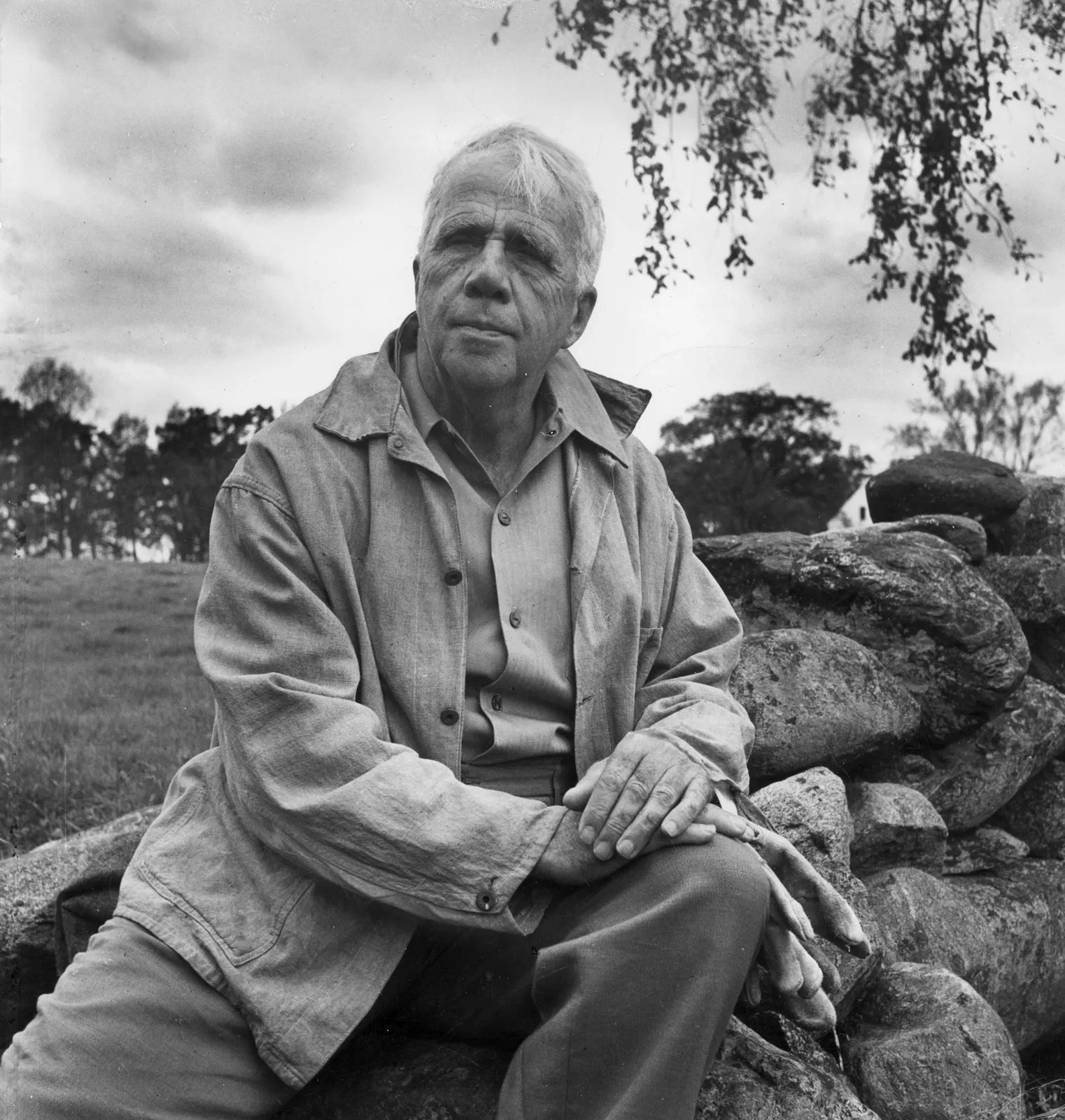 As regards the dramatic narratives of the poet Robert Frost (1954 photo at left), one might see Dana Gioia‘s essay Robert Frost and the Modern Narrative, first published in the Virginia Quarterly Review, Spring 2013.
Gioia offers these two examples from Frost’s Home Burial:
‘Don’t, don’t, don’t, don’t,’ she cried.
She withdrew shrinking from beneath his arm
That rested on the banister, and slid downstairs;
And turned on him with such a daunting look,
He said twice over before he knew himself:
‘Can’t a man speak of his own child he’s lost?’
And, secondly, from the end of “Home Burial”:
‘You—oh, you think the talk is all. I must go—
Somewhere out of this house. How can I make you—’
‘If—you—do!’ She was opening the door wider.
‘Where do you mean to go? First tell me that.
I’ll follow and bring you back by force. I will!—’
Thirdly…
Since I have been reading the Rimas of the nineteenth-century Spanish Romantic poet Gustavo Béquer, I will close with two bitexts. First the closing stanza of “Rima XXX”:
Yo voy por un camino; ella, por otro; (I walk one path; she, another.)
pero, al pensar en nuestro mutuo amor, (But, thinking of our love for one another,)
yo digo aún: «¿Por qué callé aquel día?» (I still ask myself: “Why did I stay silent that day?”)
Y ella dirá: «¿Por qué no lloré yo?» (And she will ask: “Why didn’t I cry?”)
And now, the closing stanza of Rima XXXIII, here with a more creative translation into English:
¡Lástima que el Amor un diccionario (Would that love came with a dictionary)
no tenga donde hallar (from which we might learn)
cuando el orgullo es simplemente orgullo (when pride is just pride)
y cuando es dignidad! (and when it’s something more dignified).
(I note that in the versions of this poem I have found online, los cuando come with an accent (cuándo), as if they were questions. At least in the twenty-first century this seems incorrect.)


[…] in English mainly, though with some français y español. At the very end of a previous post (We might let some light in . . . ) may be found the final stanza of Béquer’s “Rima […]