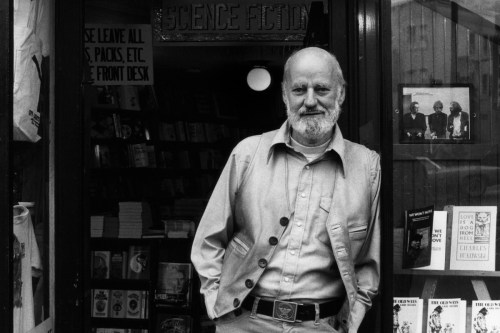
 News came this week (in February 2021) of the death (at age 101!) of one of the United States’ greatest poets and publishers: Lawrence Ferlinghetti. Readers may find below Some rambling notes from 2022 regarding Ferlinghetti, “The World is a Beautiful Place,” my family, and a recent search for a copy of Ferlinghetti’s memoir-novel Little Boy. There are versions of these notes in English, en français y en español. And at the end of the English segment there are A further note regarding “l’étrange defaite” or Phony War: France’s military effort at the outset of the Second World War.
But first:
El mundo es un lugar hermoso
Una traducción de uno de las mejores poemas de Ferlinghetti: The world is a beautiful place. (Les lecteurs français trouveront quelques passages de ce poème dans les “notes décousus“.)
El mundo es un lugar hermoso
en el cual nacer
si no te importa que la felicidad
no siempre sea
muy divertido
si no te importa un toque de infierno
de vez en cuando
justo cuando todo está bien
porque incluso en el cielo
no cantan
todo el tiempo
El mundo es un lugar hermoso
en el cual nacer
si no te importa que algunos mueran
todo el tiempo
o quizás sólo muriendo de hambre
algunas veces
que no es tan malo
si no eres tú
Oh el mundo es un lugar hermoso
en el cual nacer
si no te importa mucho
unas pocas mentes muertas
en los lugares más altos
o una bomba o dos
de vez en cuando
en tus rostros levantados
y otras incorrecciones
de que es presa
nuestra sociedad de marca
con sus hombres de distinción
y sus hombres de la extinción
y sus sacerdotes
y otros patrulleros
y sus diversas segregaciones
y investigaciones del Congreso
y otros estreñimientos
de que nuestra tonta carne
es heredero
Sí, el mundo es el mejor lugar de todos
para un montón de cosas como
para aparecer en la escena divertida
y aparecer en la escena de amor
y aparecer en la escena triste
y cantar canciones abatidoras y tener inspiraciones
y caminar por ahí
mirando todo
y oliendo las flores
y manoseando las estatuas
y aun pensar
y besar a todos y
hacer bebés y llevar pantalones
y agitar sombreros y
bailar
e ir a nadar a los ríos
de picnic
en medio del verano
y en general
festejar y divertirse
Sí
pero entonces justo en el medio de todo esto
viene el sonriente
sepulterero
English
Some rambling notes regarding Ferlinghetti, my family, and a recent search for Little Boy
In 2022, returning to New York after having moved to Paris, I had an idea to read Little Boy, the memoir-novel of Lawrence Ferlinghetti who wrote one of the very best American poems and who was also the pioneering publisher of a whole generation of nonconformist writers. I went to a large bookstore on New York’s Upper West Side and asked the clerk behind the information desk where I might find Little Boy. A diligent, unassuming young woman, she had some difficulty helping me because she had never heard of Ferlinghetti and therefore needed my help spelling his name for her computer.
Not surprisingly then, the bookstore had none of Ferlinghetti’s books, not even the 1958 A Coney Island of the Mind, which Wikipedia, perhaps a bit out of date, says “remains one of the best-selling and most popular books of poetry ever published.”
In his youth, Ferlinghetti (1919-2021) joined the Navy. He was offshore on D-Day in Normandy and then in the Pacific Theater. He had the “opportunity” to visit Nagasaki shortly after the atomic bomb had been dropped there. “Up to that time, I’d been a good American boy,” he has said. “Nagasaki really woke me up.” A decade later, with a lighter heart, he wrote from San Francisco:
The world is a beautiful place
to be born into
if you don’t mind happiness
not always being
so very much fun
if you don’t mind a touch of hell
now and then
just when everything is fine
because even in heaven
they don’t sing
all the time
The first of my family to come to what has become Massachusetts, and the United States of America, arrived in 1620. One third of the people who set out with them died on the boat during the Atlantic crossing, and another third died in the first year. Another ancestor, who came much later, from Eastern Europe, told me how he used to be so hungry, he would go to Central Park to get a glass of the raw milk that a rich philanthropist was offering. The milk caused diarrhea, and so he would run from the feeding station to the public toilets near the Bethesda Fountain.
Sometimes I wonder why, given my ancestors’ struggles to get established in the “New World,” I have returned to the old one? Sometimes in Paris I walk by the plaque in the Marais that states that one half of the Jews who came there from Eastern Europe were later killed thanks to French collaboration with the Nazis. As I have come to understand the “Phony War” against the Germans, capitalists and military leaders in France—anxious to be rid of the Leftist government, which had given French people three weeks of paid vacation, a 40-hour work week, salary increases, discounted train tickets and other, equally frightening things—capitalists and military leaders more or less agreed to cede the country to the Nazis without a fight. And it might be said that capital profited yet more from supplying the armed forces on both the Axis and Allied sides, as tens of millions of combatants and civilians were killed and a more moderate, and US-dominated, world order was established.
Oh the world is a beautiful place
to be born into
if you don’t much mind
a few dead minds
in the higher places
or a bomb or two
now and then
in your upturned faces
When I next sought Little Boy at a large bookstore across the street from Harvard Yard in Cambridge, the shelves did offer the Coney Island poetry collection, though not Little Boy. The young employees there, though friendly and enthusiastic, had also never heard of Ferlinghetti.
Instead, I bought Mario Vargas Llosa’s La tía Julia y el escribidor and Henry James’s The Bostonians. Marvelous books! Near the opening of the latter work there is a nineteenth-century feminist meeting, before which the protagonist, a young, white male Southerner come north after the Civil War, is chatting with his high-minded, well-to-do Boston cousin. She says that everyone at the meeting “will, in his way—or in her way—plead the cause of the new truths.”
“I tell you I haven’t the least idea what they are!” responds the young man. “I have never yet encountered in the world any but old truths”.
After a few weeks, it was time for me to return to Europe, my heart a bit heavy in the wake of the warm and free-ranging, but not always joyful conversations I had had with my son, who was confronting some challenges in his American life.
Waiting to get through security at the airport, I met a Hungarian-American woman of my advanced age. She was headed to Budapest with her uncle. They, too, had immigrants’ stories of struggle and hunger—the struggles of Hungarians after World War II, in refugee camps and then trying to get established in the United States.
The woman also remarked that, instead of losing themselves on the Internet, people should read books.
I asked her what books she liked to read, and she said that, what with a full-time job and all her grandchildren, she had no time to read.
Then she said that, as a Hungarian, she was raised to love poetry and memorize it. She mentioned the nineteenth century English poet Edward Lear’s The Owl and the Pussy-cat. She had long lived in Passaic, NJ, where worked for four decades Doctor William Carlos Williams (1883–1963), who has been widely recognized—and rightly or wrongly, and much more than Ferlinghetti—as one of the United States’s greatest poets. So I proposed that she must have memorized some of Williams’s poems.
She had never heard of him.
However . . . ?
Some combination of globalization and human nature means that for most every story about life in one country one can find an equivalent about life in another country. Thus, nine months after I was surprised to discover young American bookstore staff who had never heard of Ferlinghetti, I went to my local Paris library to check out a DVD of Le chagrin et la pitié (English title: The Sorrow and the Pity.) Although the library indeed has a copy of this 1969 documentary about the collaboration between the Vichy government and Nazi Germany during World War II, the librarian, a woman about 40 years old, had never heard of it.
I could not help wondering: if we’d chatted more, would she have admitted never having heard either of the Holocaust or the Second World War?
Another man might have thought to say to the librarian, “Of course you’ve heard of Le chagrin et la pitié—in Annie Hall.” (That is, in that latter, Woody Allen movie, the Woody Allen character proposes that The Sorrow and the Pity is his favorite movie.) But perhaps the librarian would have never heard of Woody Allen either?
A further note
 As regards the French response to the Nazis at the outset of the Second World War, the locus classicus is historian and army officer Marc Bloch’s 1940 L’étrange defaite (The Strange Defeat), which has come to seem to me a bit conservative in its judgments, although they are harsh! He blames the French defeat on incompetent, out-of-date leadership, though he also stresses that this leadership gave up way too soon; the war could have been pursued and with some hope of success. (At right is a German picture of French prisoners of war in May 1940.)
This from Agnès Poirer’s Left Bank: Art, Passion and the Rebirth of Paris 1940-1950:
There was something strange about this war. The French called it the ‘Drôle de guerre’, the Americans and the British the ‘Phony War’. If the French army had attacked head-on, immediately after the declaration of war, the German army could not have held out for more than one or two weeks—at least that is what the German general Siegfried Westphal stated years later during the Nuremberg trials. In September 1939, Britain and France had a combined 110 divisions to Germany’s 23.
A striking detail: In 1939—a year before the country was attacked, let alone officially surrendering—the French government was already moving the artworks out of the Louvre and warehousing them in various semi-secret places around the country. This in preparation for a German takeover of Paris.
Bloch writes:
Une grande partie de nos classes dirigeantes, celles qui nous fournissaient nos chefs d’industrie, nos principaux administrateurs, la plupart de nos officiers de réserve. . . défendaient un pays qu’ils jugeaient, d’avance, incapable de résister.
A large part of our ruling classes, those who supplied our heads of industry, our senior administrators, most of the officers in the reserves… were defending a country that they judged, in advance, incapable of resisting. [Of resisting the Nazi takeover, that is.]
Instead of France becoming socialist or communist, the ruling classes thought to make it the junior partner of a Nazi-dominated Europe. This new role infamously included rounding up French Jews and shipping them to Auschwitz.
As centrist French politician Pierre Mendès France remarks in Le chagrin et la pitié (The Sorrow and the Pity), in the late 1930s the French civil and military elite preferred Hitler to their Socialist (and Jewish) Prime Minister, Léon Blum.
Français
Quelques notes décousues à propos de Ferlinghetti, ma famille, et une recherche récente pour un exemplaire de Little Boy
En 2022, de retour à New York après m’être installé à Paris, j’ai eu l’idée de lire non pas « Asphodel » mais Little Boy, le roman-mémoire de Lawrence Ferlinghetti qui a écrit l’un des meilleurs poèmes américains et qui a été aussi l’éditeur pionnier de toute une génération d’écrivains américains non-conformistes. Je me suis rendu dans une grande librairie de l’Upper West Side de New York et j’ai demandé à l’employé derrière le comptoir d’information où je pourrais trouver Little Boy. Cette jeune femme diligente et discrète a eu quelques difficultés à m’aider car elle n’avait jamais entendu parler de Ferlinghetti et avait donc besoin de mon aide pour épeler son nom pour son ordi.
Il n’était donc pas surprenant que la librairie n’ait aucun des livres de Ferlinghetti, pas même le 1958 A Coney Island of the Mind, qui, selon un article de Wikipedia, peut-être un peu dépassé, « reste l’un des livres de poésie les plus vendus et les plus populaires jamais publiés. »
Dans sa jeunesse, Ferlinghetti (1919-2021) s’est engagé dans la Marine. Il a été au large le jour J en Normandie, puis sur le théâtre du Pacifique. Il a eu « la chance » de visiter Nagasaki peu après que la bombe atomique y ait été larguée. « Jusqu’à ce moment-là, j’avais été un bon garçon américain », a-t-il déclaré. « Nagasaki m’a vraiment réveillé. » Dix ans plus tard, le cœur plus léger, il écrit de San Francisco :
Le monde est un endroit magnifique
dans lequel naître
si ça ne vous dérange pas que le bonheur
ne soit pas toujours
si amusant
si ça ne vous dérange pas
une petite touche d’enfer
de temps en temps
juste quand tout va bien
parce que même au paradis
on ne chante pas
tout le temps
Les premiers membres de ma famille à venir dans ce qui est devenu le Massachusetts, et les États-Unis d’Amérique, sont arrivés en 1620. Un tiers des personnes qui sont parties avec eux sont mortes sur le bateau pendant la traversée de l’Atlantique, et un autre tiers est mort au cours de la première année. Un autre ancêtre, qui est arrivé beaucoup plus tard, de l’Europe de l’Est, m’a raconté qu’il avait tellement faim qu’il allait à Central Park pour prendre un verre de lait cru qu’une riche femme philanthrope offrait. Le lait provoquait la diarrhée, et il courait de la station d’alimentation aux toilettes publiques près de la Bethesda Fountain.
Je me demande parfois pourquoi, après toutes les luttes de mes ancêtres pour s’établir dans le « Nouveau Monde », je suis revenu dans l’ancien ? Parfois, à Paris, je passe devant la plaque dans le Marais qui indique que la moitié des Juifs qui se sont sauvés de l’Europe de l’Est ont été tués plus tard grâce à la collaboration de la France avec les nazis. D’après ce que j’ai compris de la « drôle de guerre » contre les Allemands, des capitalistes et des chefs militaires en France – impatient de se débarrasser du gouvernement de gauche qui avait donné aux Français trois semaines de congés payés, une semaine de 40 heures, des augmentations de salaire, des billets de train à prix réduit et d’autres choses tout aussi effrayantes – ils sont plus ou moins accepté de céder le pays aux nazis sans se battre. Et l’on pourrait dire que le capital a encore profité de l’approvisionnement des forces armées des deux camps, l’Axe et les Alliés, alors que des dizaines de millions de combattants et de civils étaient tués et qu’un ordre mondial plus modéré, et dominé par les États-Unis, était établi.
Oh, le monde est un endroit magnifique
dans lequel naître
si vous ne vous souciez pas trop
quelques esprits morts
dans les lieux élevés
ou une bombe ou deux
de temps en temp
dans vos visages relevés
Lorsque j’ai ensuite cherché Little Boy dans une grande librairie située de l’autre côté de la rue de Harvard Yard, à Cambridge, les rayons offraient bien le recueil de poésie A Coney Island of the Mind, mais pas Little Boy. Les jeunes employés là-bas, quoique sympathiques et enthousiastes, n’avaient jamais entendu parler de Ferlinghetti non plus.
À la place, j’ai acheté La tía Julia y el escribidor de Mario Vargas Llosa et The Bostonians de Henry James (tous les deux les merveiles). Ce dernier ouvrage s’ouvre sur une réunion féministe du XIXe siècle. Avant elle, le protagoniste, un jeune homme blanc du Sud, venu dans le Nord après la guerre de Sécession, discute avec sa cousine de Boston, une femme d’une grande élévation morale et aisée. Elle dit que tout le monde à la réunion, surtout les femmes, allaient « plaider la cause des nouvelles vérités ».
« Je vous dis que je n’ai pas la moindre idée de ce qu’elles sont ! » répond le jeune homme. « Je n’ai encore jamais rencontré dans le monde que des vérités anciennes ».
Après quelques semaines, il était temps pour moi de retourner en Europe, le cœur un peu lourd à la suite des conversations chaleureuses et libres, mais pas toujours joyeuses, que j’avais eues avec mon fils, qui était confronté à certains défis dans sa jeune vie américaine.
En attendant de passer la sécurité à l’aéroport, j’ai rencontré une Américaine d’origine hongroise, et de mon âge avancé, qui se rendait à Budapest avec son oncle. Eux aussi avaient des histoires de lutte d’immigrants, y compris contre la faim – les luttes des Hongrois après la Seconde Guerre mondiale, dans les camps de réfugiés et puis en essayant de s’établir aux États-Unis.
À un autre moment, la femme a fait remarquer qu’au lieu de se perdre sur Internet, les gens devraient lire des livres.
Je lui ai demandé quels livres elle aimait lire, et elle a répondu que, avec un travail à plein temps et tous ses petits-enfants, elle n’avait pas le temps de lire.
Puis elle a dit que, en tant que Hongroise, elle avait été élevée dans l’amour de la poésie et dans la mémorisation de celle-ci. Elle a mentionné « The Owl and the Pussy-cat » du poète anglais du XIXe siècle Edward Lear.
Elle avait longtemps vécu à Passaic, NJ, la patrie de William Carlos Williams (1883-1963), largement reconnu – à tort ou à raison, et bien plus que Ferlinghetti – comme l’un des plus grands poètes des États-Unis. J’ai donc proposé qu’elle ait dû mémoriser certains des poèmes de Williams.
Elle n’avait jamais entendu parler de lui.
Cependant… ?
La mondialisation, combinée à la nature humaine, fait que pour presque chaque anecdote sur la vie dans un pays, on peut en trouver une équivalente dans un autre. Ainsi, neuf mois après avoir été surpris de découvrir de jeunes employés d’une librairie américaine qui n’avaient jamais entendu parler de Ferlinghetti, je me suis rendu à ma bibliothèque de quartier à Paris pour emprunter un DVD de Le Chagrin et la Pitié. Bien que la bibliothèque dispose effectivement d’un exemplaire de ce documentaire de 1969 sur la collaboration entre le gouvernement de Vichy et l’Allemagne nazie pendant la Seconde Guerre mondiale, la bibliothécaire, une femme d’une quarantaine d’années, n’en avait jamais entendu parler.
Je ne pouvais m’empêcher de me demander : si nous avions discuté davantage, aurait-elle admis n’avoir jamais entendu parler ni de l’Holocauste ni de la Seconde Guerre mondiale ?
Un autre homme aurait peut-être pensé à dire à la bibliothécaire : « Bien sûr que vous avez entendu parler de Le Chagrin et la Pitié — dans Annie Hall. » (Dans ce film de Woody Allen, le personnage incarné par Woody Allen affirme que Le chagrin et la Pitié est son film préféré.) Mais peut-être que la bibliothécaire n’aurait jamais entendu parler de Woody Allen non plus ?
Español
Algunas notas sueltas sobre Ferlinghetti, mi familia, y una búsqueda reciente de un ejemplar de Little Boy
En 2022, al volver a Nueva York después de haberme trasladado a París, se me ocurrió leer no “Asphodel”, sino Little Boy, la novela-recuerdo de Lawrence Ferlinghetti, que escribió uno de los mejores poemas estadounidenses y que fue también el editor pionero de toda una generación de escritores inconformistas. Fui a una gran librería del Upper West Side de Nueva York y pregunté al dependiente del mostrador de información dónde podía encontrar Little Boy. Una joven diligente y modesta, tuvo algunas dificultades para ayudarme porque nunca había oído hablar de Ferlinghetti y, por tanto, necesitaba mi ayuda para deletrear su nombre en su ordenador.
No es de extrañar, pues, que la librería no tuviera ninguno de los libros de Ferlinghetti, ni siquiera el de 1958, A Coney Island of the Mind, que según Wikipedia, quizá un poco desfasada, “sigue siendo uno de los libros de poesía más vendidos y populares jamás publicados”.
En su juventud, Ferlinghetti (1919-2021) se alistó en la Marina. Estuvo en alta mar el Día D en Normandía y luego en el Teatro del Pacífico. Tuvo la “oportunidad” de visitar Nagasaki poco después de que se lanzara allí la bomba atómica. “Hasta ese momento, había sido un buen chico americano”, ha dicho. “Nagasaki realmente me despertó”. Una década más tarde, con un corazón más ligero, escribió desde San Francisco:
El mundo es un lugar hermoso
en el cual nacer
si no te importa que la felicidad
no sea siempre
muy divertido
si no te importa un roce de infierno
de vez en cuando
justo cuando todo está bien
porque incluso en el cielo
no cantan
todo el tiempo
Los primeros miembros de mi familia que llegaron a lo que se ha convertido en Massachusetts, y a los Estados Unidos de América, llegaron en 1620. Un tercio de los que partieron con ellos murió en el barco durante la travesía del Atlántico, y otro tercio murió en el primer año. Otro antepasado, que llegó mucho más tarde, procedente de Europa del Este, me contó cómo solía tener tanta hambre que iba a Central Park a por un vaso de leche cruda que ofrecía un rico filántropo. La leche le provocaba diarrea, por lo que corría desde el comedero hasta los aseos públicos cercanos a la Bethesda Fountain.
A veces me pregunto por qué, teniendo en cuenta todas las luchas de mis antepasados por establecerse en el “Nuevo Mundo”, he vuelto al antiguo. A veces, en París, paso por delante de la placa del Marais que dice que la mitad de los judíos que llegaron allí desde Europa del Este fueron asesinados posteriormente gracias a la colaboración francesa con los nazis. Como he llegado a entender la “Guerra Ficticia” contra los alemanes, los capitalistas y militares de Francia -ansioso por deshacerse del gobierno de izquierdas, que había dado a los franceses tres semanas de vacaciones pagadas, una semana laboral de 40 horas, aumentos salariales, descuentos en los billetes de tren y otras cosas igualmente aterradoras- acordaron más o menos ceder el país a los nazis sin luchar. Y podría decirse que el capital se benefició aún más del abastecimiento de las fuerzas armadas tanto del Eje como de los Aliados, mientras decenas de millones de combatientes y civiles eran asesinados y se establecía un orden mundial más moderado y dominado por los Estados Unidos de América.
Oh el mundo es un lugar hermoso
en el cual nacer
si no te importa mucho
unas pocas mentes muertas
en los lugares altos
o una bomba o dos
de vez en cuando
en tus rostros levantados
Cuando volví a buscar Little Boy en una gran librería frente a Harvard Yard, en Cambridge, las estanterías ofrecían la colección de poesía A Coney Island of the Mind, aunque no Little Boy. Los jóvenes empleados, aunque amables y entusiasmados, tampoco habían oído hablar de Ferlinghetti.
En su lugar, compré La tía Julia y el escribidor, de Mario Vargas Llosa, y The Bostonians, de Henry James (¡maravillosos libros!). Esta última obra se abre con una reunión feminista del siglo XIX ante la cual el protagonista, un joven blanco sureño llegado al norte después de la Guerra Civil, está charlando con su prima bostoniana, una mujer de alto nivel moral y de riqueza. Dijo que todos en la reunión, especialmente las mujeres, iban a “abogar por las nuevas verdades”.
“¡Te digo que no tengo la menor idea de lo que son!”, responde el señorito. “Nunca he encontrado en el mundo más que viejas verdades”.
Al cabo de unas semanas, llegó el momento de volver a Europa, con el corazón un poco encogido por las conversaciones cálidas y libres, pero no siempre alegres, que había mantenido con mi hijo, que se enfrentaba a algunos retos en su joven vida americana.
Mientras esperaba para pasar el control de seguridad en el aeropuerto, conocí a una mujer húngara-estadounidense de mi edad avanzada que se dirigía a Budapest con su tío. Ellos también tenían historias de lucha y hambre de los inmigrantes: las luchas de los húngaros después de la Segunda Guerra Mundial, en los campos de refugiados y luego tratando de establecerse en los Estados Unidos.
En otro momento, la mujer comentó que, en lugar de perderse en Internet, la gente debería leer libros.
Le pregunté qué libros le gustaban, y me dijo que, con un trabajo a tiempo completo y todos sus nietos, no tenía tiempo Sin embargopara leer.
Luego dijo que, como húngara, fue educada para amar la poesía y memorizarla. Mencionó “The Owl and the Pussy-cat” del poeta inglés del siglo XIX Edward Lear.
Hacía tiempo que vivía en Passaic, NJ, la tierra natal de William Carlos Williams (1883-1963), ampliamente reconocido -con razón o sin, y mucho más que Ferlinghetti- como uno de los mejores poetas de Estados Unidos. Así que le propuse que debía haber memorizado algunos poemas de Williams.
Ella nunca había oído hablar de él.
Sin embargo…
La globalización, unida a la naturaleza humana, hace que, por cada anécdota sobre la vida en un país, se pueda encontrar otra equivalente en otro. Así, nueve meses después de sorprenderme al descubrir que unos jóvenes empleados de una librería estadounidense nunca habían oído hablar de Ferlinghetti, me acerqué a mi biblioteca de barrio en París para sacar un DVD de Le Chagrin et la Pitié (El dolor y la piedad). Aunque la biblioteca disponía efectivamente de un ejemplar de este documental de 1969 sobre la colaboración entre el gobierno de Vichy y la Alemania nazi durante la Segunda Guerra Mundial, la bibliotecaria, una mujer de unos cuarenta años, nunca había oído hablar de él.
No pude evitar preguntarme: si hubiéramos hablado un poco más, ¿habría admitido que nunca había oído hablar ni del Holocausto ni de la Segunda Guerra Mundial?
Quizá otro hombre habría pensado en decirle a la bibliotecaria: «Claro que has oído hablar de Le Chagrin et la Pitié —en Annie Hall. » (En esta película de Woody Allen, el personaje interpretado por el propio Woody Allen afirma que Le Chagrin et la Pitié (“The Sorrow and the Pity”) es su película favorita.) Pero, ¿quizás la bibliotecaria tampoco habría oído hablar nunca de Woody Allen?
— The rambling notes and the translation of Lawrence Ferlinghetti’s poem are the work of William Eaton.
Many thanks to María Aguilar Moreno, director of the Spanish program at Saint Gabriel International Sevilla; to Ana Roca Gadea, Jefa de Biblioteca at the Biblioteca Octavio Paz – Instituto Cervantes de París; and to my old friend Adelino Pereira for their help translating the English phrase “to make the scene.” Apparently this phrase, well known to me, as to Ferlinghetti, has fallen out of common usage, and so the usual translation tools were of little help. Adelino got me from English to French (se montrer), and this led to three Spanish possibilities: mostrarse, dejarse ver y aparacer en (this latter being the one used above).
Dictionary.com offers this as regards the phrase (to make the scene):
Put in an appearance, take part in an event, as in “I’ll miss most of the party, but I hope to make the scene before midnight.” Slang; mid-1900s.
Allow me to also thank the Colombian author Juan Gabriel Vásquez for the word “manoseando,” which, in January 2024, I encountered in his 2013 novel Las reputaciones. Previously, I was having Ferlinghetti celebrate the possibility of “acariciando” statues.
Ferlinghetti’s comment about visiting Nagasaki was made during an interview: Poet Lawrence Ferlinghetti Tells Robert Scheer: I Am Not a Beat!
The photograph of Ferlinghetti in front of his City Lights bookstore in San Francisco was taken by Janet Fries in 1977. “The world is a beautiful place” appeared as the third to last poem in Ferlinghetti’s bestselling collection, A Coney Island of the Mind (New Directions, 1958). The poem there is untitled; “The world . . . ” is the first line.
A Coney Island of the mind & autres poèmes, Bilingue, anglais-français, traduction de Marianne Costa. Je n’ai pas encore vu ce livre, mais il devrait comprendre une traduction en français de “The world is a beautiful place.”


muy hermosa traducción excelente poema
¡Gracias! ¡Y bienvenido!
Lovely
Thank you!
Excelent
¡Gracias!
Wahou
This is beautiful