I have been waiting to stumble upon a new form, or forms, for my poems, something more suited to our twenty-first century crises and (minimal) reading habits. The present short poem—English followed by une version en français y una versión en español— has seemed to be heading in a fruitful direction.
Somewhat similarly, I have an interest in very simple drawings and paintings. Thus the two images offered here. And it is always a pleasure to be able to cite others’ texts that I have enjoyed or that have contributed to my evolution. Thus the Robert Creeley & Paul Éluard poems copied below my English text.
As for the subject matter, it is taken up in a short essay published (trilingually) in 2024: Three notes on the current dilemma (le dilemme actuel, el dilema actual).
What about the bicycle?
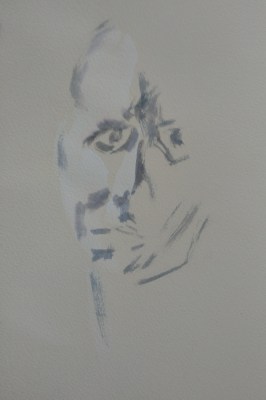
It would seem that of late we have a habit
Of inventing things that, within a few decades
Or less, prove less wonderful
Than at first blush.
Plastics are what got me started here,
And there are automobiles, nuclear weapons, cellphones.
Though, of course, there will be someone to say:
What about the bicycle?
Antibiotics, some forms of democracy
Which we seem to be losing track of.
Creeley & Éluard poems
Robert Creeley: The Dishonest Mailmen
They are taking all my letters, and they
put them into a fire.
I see the flames, etc.
But do not care, etc.
They burn everything I have, or what little
I have. I don’t care, etc.
The poem supreme, addressed to
emptiness—this is the courage
necessary. This is something
quite different.
N.B.: One can find this poem in varying formats; for example, without being divided into two-line stanzas, or with the “I see the flames, etc.” indented.
Paul Éluard : Les petites justes, VIII
De « Capitale de la douleur », 1926
Elle se refuse toujours à comprendre, à entendre
Elle rit pour cacher sa terreur d’elle-même.
Elle a toujours marché sous les arches des nuits
Et partout où elle a passé
Elle a laissé
L’empreinte des choses brisées.
N.B.: One might see further le triangle de son nez (the wedge of her nose).
Français
Et la bicyclette, le vélo ?
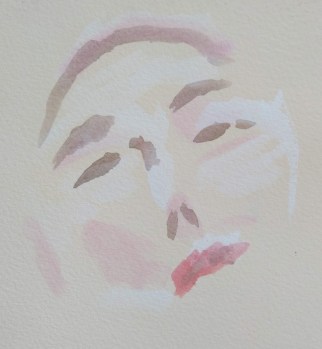
Il semble que nous ayons pris l’habitude
D’inventer des choses qui, quelques décennies plus tard
Ou moins, se révèlent moins merveilleuses
Qu’elles ne le semblaient à première vue.
C’est le plastique qui m’a lancé cette fois-ci,
Et il y a aussi les automobiles, les armes nucléaires, les téléphones portables.
Quoique, bien sûr, il y aura quelqu’un pour dire :
« Et la bicyclette, le vélo ? »
Les antibiotiques, certaines formes de démocratie
Dont nous semblons perdre la trace.
Español
¿Y la bicicleta?
Parece que últimamente tenemos la costumbre
de inventar cosas que, en unas pocas décadas
o menos, resultan menos maravillosas
de lo que parecía a primera vista.
Fue el plástico lo que me hizo empezar esta vez,
y hay automóviles, armas nucleares, teléfonos móviles.
aunque, por supuesto, alguien dirá:
¿Y la bicicleta?
Los antibióticos, algunas formas de democracia
a las que parece que le estamos perdiendo la pista.
— The bicycle poem(s) and the drawings are by William Eaton.

