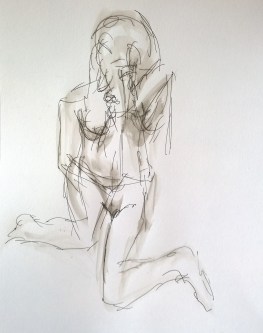
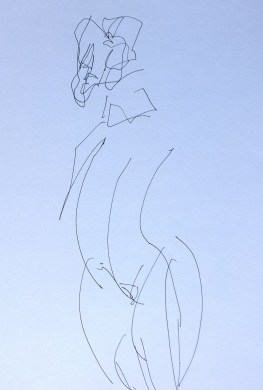
An odd, short text created perhaps more to illustrate the two drawings than to be illustrated by them? Le brouillon d’une version en français se trouve ci-dessous.
“So, OK, what have I learned—that there’s at least one other non-normal person?”
 She thought there were normal people and that she might not be one of them. If you had asked her what a normal person was, she would have said that such people had nothing terrible wrong with them; they belonged and deserved to belong and had no reason to be ashamed.
Wishing to help her, he went looking for such people. He kept being told that there was a man or woman—such a normal person!—living in the next town over. You never get to the next town, he eventually realized.
He hurried back to her to tell her, with a smile, of his adventures.
She dismissed them. She already knew he wasn’t a normal person.
Brouillon pour une version en français
« Bon, alors, qu’est-ce que j’ai appris ? Qu’il y a au moins une autre personne qui n’est pas normale ? »
Elle pensait qu’il y avait des gens normaux et qu’elle n’en faisait pas forcément partie. Si vous lui aviez demandé ce qu’est une personne normale, elle aurait dit que de telles gens n’avaient pas raison d’avoir honte. Personne n’a même pensé à se poser des questions à leur sujet. Personne n’a même pensé à se méfier d’eux. Ils existaient, respiraient.
Désireux de l’aider, il est allé à la recherche de ces gens. Maintes fois on lui a dit qu’il y avait un homme ou une femme – exactement comme ça, normale ! – qui vivait dans une ville avoisinante. Viens le moment quand on se rende compte qu’on n’arrive jamais à une prochaine ville.
Le pied léger, il est reparti chez elle, et, pas sans un sourire, lui a raconté ses aventures.
Elle les a écartées. Elle savait déjà qu’il ne faisait pas partie des gens normaux.
— English text, French adaptation and drawings by William Eaton. A series of drawings done with eyes closed may be found decorating Art, Sex, Politics, one of the two collections of Eaton’s essays that have been published by Serving House Books.
 ∩ À noter : Two decades ago I wrote a series of “sequences”: short texts slightly more developed than this one here. Montaigbakhtinian.com was created in order to make those texts—e.g. Flip-flops, Walking to work one morning, Transgression—available online. And some of them were later collected in Surviving the Twenty-First Century (more below).
¡Cuidado! The blog would now seem headed into multilingualism.
(Traduction.) Il y a déjà un moment, j’ai écrit une série de courts textes en prose anglaise un peu plus élaborés que celui-ci. Ce site, Montaigbakhtinian.com, a été créé afin de rendre ces textes disponibles en ligne. Certains d’entre eux ont été collectés plus tard dans Surviving the Twenty-First Century (voir ci-dessous).
Mais soyez vigilants, il semblerait que le blog ait choisi de se tourner vers le multilinguisme.
Now available from Amazon: Art, Sex, Politics
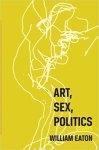 In a new, provocative collection of essays, William Eaton, the author of Surviving the Twenty-First Century, shares the pleasures of questions, tastes, reading and more visual arts. “That we are animals, that is as sure as ever. How savagely we behave! And how affectionately rub up against one another. How, desperately, make love?”
Five-star review: “ . . . remarkable collection of essays. . . . insights which carry the reader into a world of mindfulness. One of the pleasures of reading a book by Mr. Eaton is to witness the author peeling away the layers of his stories. His essay concerning “savoring,” for example, first touches on food habits, yet is in fact a call to live with intention; to savor life as one would savor a meal. . . . lovely prose . . . delightful book.”
Kind words about Surviving: “Entertaining, yet packs a quiet intellectual wallop. . . . so thought-provoking and poetic I didn’t want it to end . . . beautiful and wise and moving . . . engaged, non-doctrinaire, well-read, independent-minded. . . . William Eaton finds arresting themes in unusual places. . . . The writing is masterful and wonderfully absorbing.”

