Explanation and semi-original poem by William Eaton in English, followed by Eaton’s versions of Robert Frost’s sonnet Design en français y en español.
 The explanation: I was reading alternately two rather different poetry collections. On the one hand, Laurence Perrine and James M. Reid’s 100 American Poems of the Twentieth Century (1966), which includes the editors’ expert commentary on each of the poems. On the other hand, Philip Larkin’s excellent volume, The Oxford Book of 20th Century English Verse (1973), in which the poems are presented without commentary. This led me, however accidentally, to think of prominent twentieth-century American poets as creating dense puzzles for expert readers to explicate. While English poets of that time—less desperate or high strung? less dependent on university professorships? or simply living in a country that valued poetry more highly—the English poets seemed to be speaking to a larger audience and to be content to make their points clearly and in forms well known or not requiring expert explication.
From this perspective, T.S. Eliot’s “The Wasteland,” though included in both volumes, seemed to belong on the American side. One example of the English approach is Hugh MacDiarmid’s The Storm-Cock’s Song, which I posted, along with my translations of it into French and Spanish, some years ago.
To explore this, however accidental, idea about the two, divergent national styles, I took one of the American poems—Robert Frost’s “Design”—and converted it to a more English (or Larkin-y) style. Result below!
 I note firstly that Frost—rather than, say, Wallace Stevens—may seem an odd choice, his best-known poems featuring a poetic plain-speaking. Secondly, from what I’ve glimpsed online, Frost’s poem has been taken quite seriously, as it includes death and deception (a medicinal plant proving dangerous), and calls into question the benevolence of God’s plan, if plan or God there is. Yes, OK, but it seems to me that with this poem Frost is also having some fun!
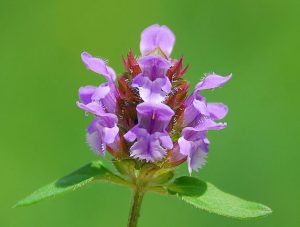
The plant, Prunella vulgaris, is edible or can be made into a tea. While it may not live up to its “heal-all” common name, it can, I have read, be a remedy for several throat ailments. Normally, its flowers are purple or blue, though each bloom has white-edged lips, and the bracts (leaf-like structures) are covered in small, white bristles.
As regards the newspaper that pops up in the penultimate stanza of the pastiche, please note that Frost’s poem was written in the 1930s.
English
Here’s how I’m imagining Mr. Frost’s “Design”
A POET MORNING WALKING over local fields,
Surprised – by design? – by a lovely flower.
“Heal-all,” “self-heal” were among the common names,
Which vaunted – deceptively? – medicinal powers.
Usually bluish, now it shone, pale in the sun,
Hugging a pale moth, on the other side of life,
By a spider-god’s design ghastly entrapped?
Mid the darkness obscuring, and petal-lips bright.
Strange, harmonious discrepancies,
Insect fooling insect in hungry, midnight flight,
Where here the goodness, grace infinite and wise?
A lonely seeker killed for some hairy beast’s delight?
WITH DEATH, hunger, confusion, suffering,
Humans, we, way too often meet.
And we can wonder, rage; many of us wish . . .
O that greedy business people less greedily might eat!
Yet many insist: there’s still a plan and good,
A wisdom guides the flowers, the insects and me.
Or do the glare, the scents and cents, all of us mislead?
(With God creating poets to embellish the misdeeds?)
MEANWHILE CAN WE IMAGINE that New England day,
The web’s evil technology, wind-defying might,
And a newspaper, as ever, spoiling for a fight,
Galling a poet’s lunch with browns and greens and whites?
For pencils sharp, Frost he asked, and for sheets of paper;
Along with his thesaurus, to make his rhyming right.
O bring me words tremendous that to our fate refer!
And ideas so clever knit, death hides from their light?
Français
Encore une fois, il s’agit d’une traduction assez libre du poème de Robert Frost (Design) et non du pastiche en anglais ci-dessus.
Design
Une araignée à fossettes, aussi grosse que blanche,
Enlaçait une blanche Brunelle, une mite égarée.
Un morceau fin de satin blanc, blanc mais trop rigide,
Son silence rappelle sa faim, la mortalité.
Bien mélangés et bien prêts, en cette belle journée,
Pour se faire un bouillon riche, même diabolique.
Une araignée qui heureuse trouve la vie remplie
A côté de ce voyageur, à la perte abandonné.
Au lieu de rester toujours bleu, le signe de sa bonté,
Cette Brunelle demandait de sembler aussi blanche ?
Pour attirer une pauvre crédule qui errais dans la nuit ?
Y a-t-il un but lugubre lié aux telles horreurs ?
Ou peut le dessein négliger nous, et d’autres choses petites ?
Ω
La Brunelle commune (Prunella vulgaris ou Brunella vulgaris) est une plante herbacée vivace de la famille des Lamiacées. C’est une plante cosmopolite héliophile, qui se plait en bordure de route et de bois, et dans les prés. On la nomme également petite consoude, charbonnière, prunelle, herbe au charpentier et brunette. Cette plante est réputée être un carminatif, anti-inflammatoire, antipyrétique, antiseptique, antispasmodique, antiviral, astringent. Elle est utilisée pour réduire la fièvre, soulager les maux de gorge, la toux et les malaises dus au rhume. Ses qualités stomachiques la font aussi utiliser pour soulager les crampes d’estomac et les aigreurs et réduire la diarrhée et les vomissements.
Español
Una vez más, se trata de una traducción bastante libre del poema de Robert Frost (Design) y no del pastiche en inglés que figura más arriba.
Diseño
Encontré una gran araña, blanca con hoyuelos,
sobre un consuelda menor, blanca, con polilla.
Un trozo de satén blanco, blanco y rígido,
figuras de la muerte, figuras de la plaga,
listas para dar comienzo a la madrugada,
ingredientes de un brebaje de brujas:
escama de araña gorda, espuma de pálida flor,
con las alas muertas – una cometa de papel.
En lugar de azul, el signo de su bondad,
¿Por qué se había puesto tan blanca esta flor?
¿Qué llevó a la araña a esa altura precisa,
Y llevó a la polilla blanca en la noche aquí?
¿Acaso algo oscuro busca a todos horrorizar?
Si el diseño gobierna en una cosa tan pequeña.
Ω
La consuelda menor (Prunella vulgaris) es una especie de planta medicinal con flores, perteneciente a la familia Lamiaceae. Es tomado internamente como un té medicinal para el dolor de garganta, fiebre, diarrea, hemorragias internas, y para aliviar dolencias de hígado y corazón. Una cataplasma de consuelda también puede servir como agente desinfectante.
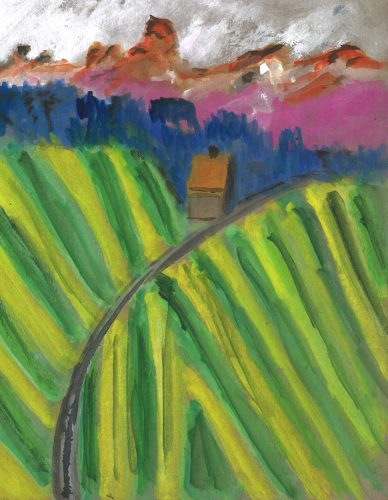
— Poem (pastiche), translations and “cover” (homepage) drawing by William Eaton.
A similar Montaigbakhtinian effort: A distillation of Whitman’s “Vigil Strange I Kept on the Field one Night”. One might also see Allen Ginsberg – Sutra del girasol, Sutra du tournesol – Sunflower Sutra.


[…] William Eaton. In 2026 I changed the artwork after realizing that I had used it again, to decorate Design, dessein, diseño (after Robert Frost) […]