English followed by une version en prose français y una versión en prosa española. Veuillez noter que la dernière ligne du texte anglais, avec son double sens, s’est avérée difficile à traduire (última línea, doble sentido, difícil de traducir). I note as well that a friend and I have been discussing the various meanings of the word “irony.”
The backstory:
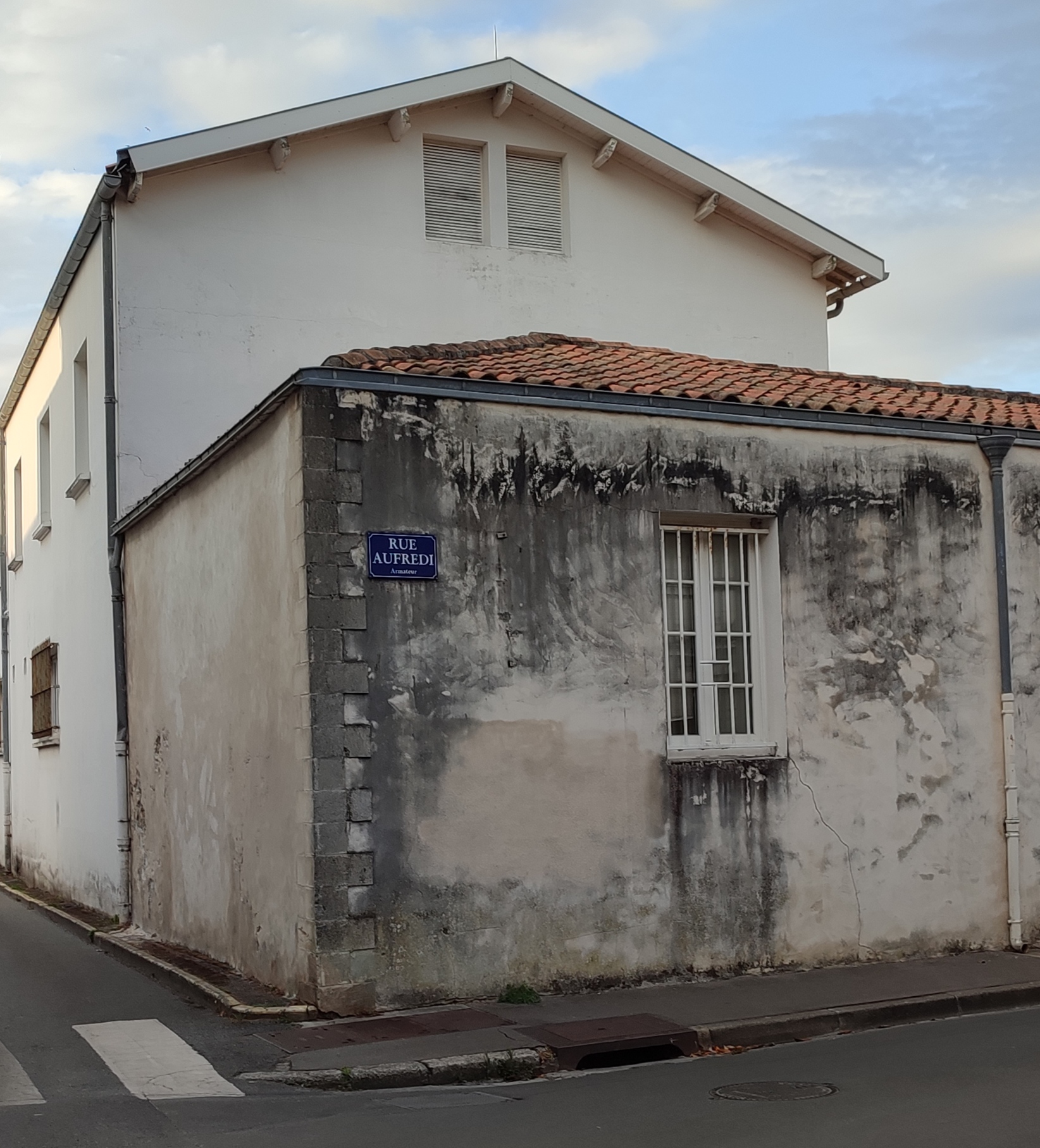 I happened to pedal past a street sign in La Rochelle (photo at right). It indicates that this Monsieur Aufredi was un “armateur”: a ship owner. Quelques extraits de la biographie from Wikipédia:
In 1196, he decided to send the seven ships of his merchant fleet on an expedition to the African coast, loaded with salt and wine. Years passed, but his ships did not return.
Alexandre Aufrédy, now ruined, was forced to sell all of his possessions, including his mansion, to pay off his debts, and was reduced to begging.
In 1203, he was saved from poverty by the unexpected return of his merchant fleet, which he had believed lost; its cargo of gold, ivory, spices, and precious woods restored his fortune.
In gratitude to Heaven, he decided to devote his life and fortune to the poor, and founded a hospital bearing his name, where, together with his wife Pernelle, he cared for the sick until his death.
Spelled “Auffredi” by Balzac, he is mentioned In Splendors and Miseries of Courtesans (1847), Balzac writes:
Les fortunes colossales des Jacques Cœur, des Médici, des Ango de Dieppe, des Auffredi de La Rochelle, des Fugger, des Tiepolo, des Corner furent jadis loyalement conquises (…); mais aujourd’hui, (…) la concurrence a si bien limité les profits, que toute fortune rapidement faite est : ou l’effet d’un hasard et d’une découverte, ou le résultat d’un vol légal.
The colosal fortunes of the Jacques Cœur, the Medici, the Ango of Dieppe, the Auffredi of La Rochelle, the Fuggers, the Tiepolo, and the Corner were once honestly amassed; but today, competition has so severely limited profits that any fortune made quickly is either the result of chance and a discovery, or the result of legalized theft.
All this notwithstanding, after another 5 minutes or so of bike riding the following poem had begun mushrooming in my head.
English
Isn’t it just the fact that you are not?
There was in our town a short street: Anderson.
And a few peeked online or were heard to insist:
“But what on earth’d he do, this Anderson man?”
And another might say, “or this Ms. or this Miss”?
But the question remained with answer none.
It seemed there was nothing by Anderson done.
He lived and he earned and was seen in cafés,
Until the ambulance arrived near the end of his days.
So why then with Washingtons and all of the rest,
This naming of a street for a gentleman who
Nothing special never did, nor once wanted to?
(And even at his job he was far from the best.)
And if for humdrumness he should be cited,
Our town featured many just so qualified –
John Walker for one, and the three misses Frye,
If you really wanted people no one excited.
Were we back in old Athens, choosing by lot,
Was money paid, a joke intended, or what
Ever led our town to Anderson enshrine?
Is not being ordinary a bad enough sign?
Français
Est-il juste ou justement parce que vous ne l’êtes pas ?
Il y avait dans notre ville une petite rue : Anderson. Et certains jetaient un œil sur Internet ou insistaient à voix haute : « Mais qu’a-t-il donc fait, ce Monsieur Anderson ? » Et d’autres pouvaient ajouter : « Ou cette madame, ou mademoiselle ? »
Mais toutes ces questions restaient sans réponse. Il semblait qu’Anderson n’ait rien accompli. Il vivait, il gagnait sa vie, et on le voyait dans les cafés, jusqu’à ce que l’ambulance arrive.
Alors pourquoi, parmi les Aufredi, les Balzac et tous les autres, a-t-on donné le nom d’une rue à un homme qui n’a jamais rien fait de spécial, ni même voulu le faire ? (Et même dans son travail, il était loin d’être le meilleur.)
Et si c’est pour sa banalité qu’il devait être cité, notre ville comptait bien d’autres personnes tout aussi qualifiées – Jean Martin, pour ne citer que lui, et les trois demoiselles Carpentier, si l’on cherchait vraiment des gens qui n’enthousiasmaient personne.
Était-on de retour dans l’Athènes antique, choisissant par tirage au sort ? Ou de l’argent a-t-il été versé, ou bien s’agissait-il d’une plaisanterie, ou qu’est-ce qui a bien pu pousser notre ville à consacrer Anderson ? Le fait de ne pas être ordinaire n’est-il pas un signe assez mauvais ?
Español
¿Es justo o precisamente porque tú no lo eres?
En nuestro pueblo había una calle corta: Anderson. Y algunos echaban un vistazo en Internet o se les oía insistir: «Pero, ¿qué demonios hizo este tal Anderson?». Y otro podría decir: «¿O esta señora o esta señorita?».
Pero todas estas preguntas quedaron sin respuesta. Parecía que Anderson no había hecho nada. Vivía, se ganaba la vida y se le veía en los cafés, hasta que llegó la ambulancia.
Entonces, ¿por qué, junto a los Goyas, Cervantes y todos los demás, se bautizó una calle con el nombre de un caballero que nunca hizo nada especial, ni siquiera una vez, ni siquiera quiso hacerlo? (E incluso en su trabajo estaba lejos de ser el mejor.)
Y si es por su banalidad que debía ser citado, nuestra ciudad contaba con muchas otras personas que reunían esos requisitos: Juan García, por ejemplo, y las tres señoritas Rodríguez, si realmente se buscaba a gente que no entusiasmara a nadie.
¿Estábamos de vuelta en la antigua Atenas, eligiendo por sorteo, o se pagó dinero, fue una broma, o qué llevó a nuestra ciudad a consagrar a Anderson? ¿Acaso el hecho de no ser normal no es una señal bastante mala?
— Poem and prose translations by William Eaton.
The “featured image” of the two street signs is from an online advertisement for a company that will make custom street signs for you.
For more, not signs but poems: Surviving the Twenty-First Century, the more personal of the two collections of Eaton’s essays that have been published by Serving House Books.

